

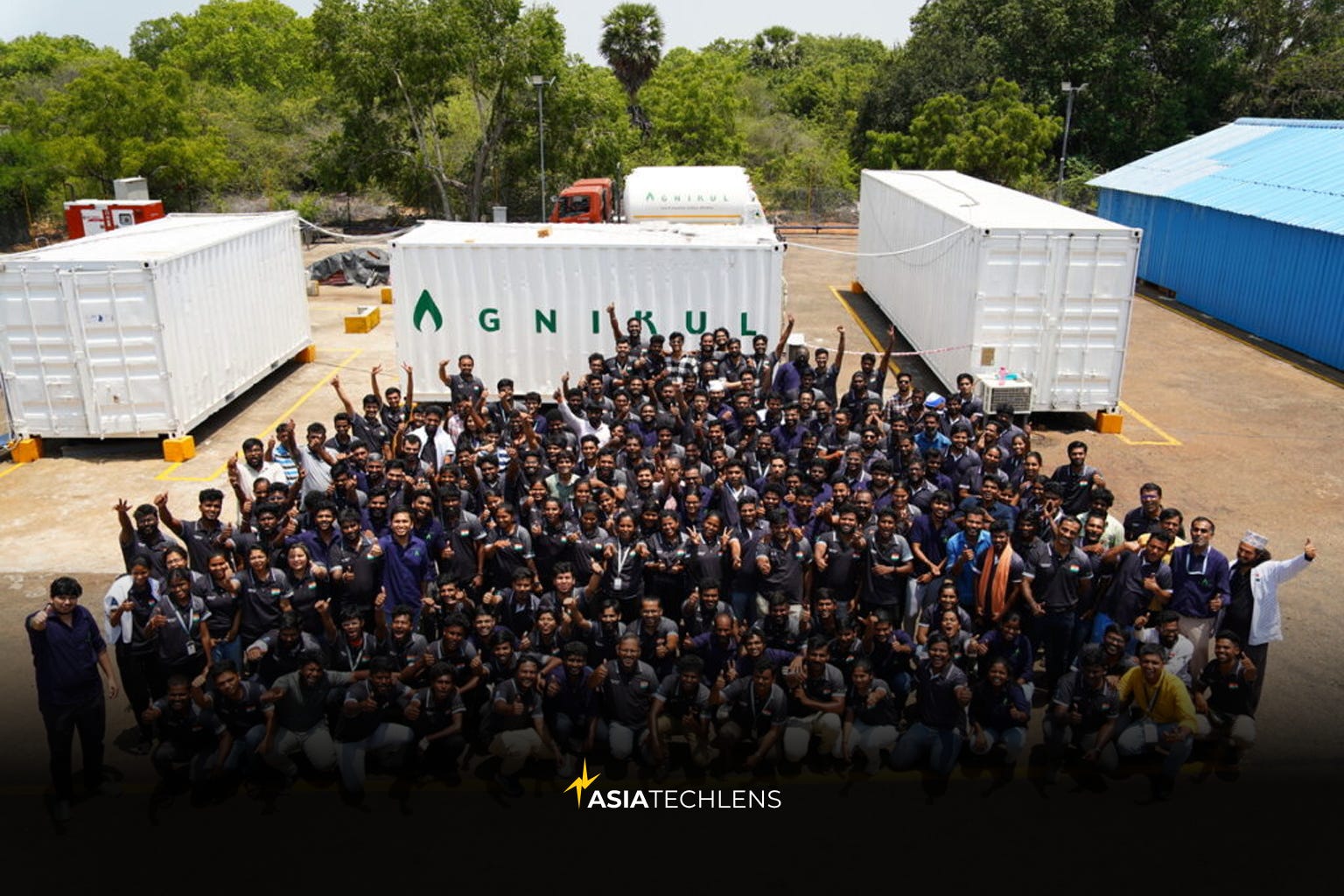
India has traditionally not been known for its deep tech industry, but companies like Agnikul Cosmos, a rocket maker, are rewriting that narrative—placing India, and to that end, Asia, as the next frontier when it comes to space tech.
Historically, India’s tech sector has been defined by the IT and software services giants, the internet consumer businesses, and its vast engineering talent pool.
But the deep tech sector is still considered a risky bet. Not many investors are willing to back a sector that demands them to be more patient with their capital, especially considering the option of backing the internet businesses that could generate faster returns.
Against such a backdrop, the recent news of an aerospace company successfully raising funding is a major accomplishment. Just this week, Agnikul Cosmos, an aerospace company founded in 2017 in Chennai, managed to raise a US$17 million Series C round. The latest funding brought its valuation to half a billion. To date, the company has raised US$58 million to fund the designing, manufacturing and launching of rockets into the Low Earth Orbit (LEO).
While the company is not the only rocket maker in the country, the other aerospace startup, Skyroot, raised its last funding in October 2023—a US$27.5 million round led by Singapore’s Temasek. The gap between Skyroot’s last raise and Agnikul’s is not trivial. It underscores how small the private aerospace sector remains, and how rarely capital flows through it.
The recent news is significant because it signals something deeper than just a belief in one company—it indicates there is a change in momentum. Agnikul signifies a deep tech awakening in India. And to a broader extent, in Asia as well.
And for a country, or a region, to make a name for itself as a deep tech player, space needs to be on its horizon.
Why Space Matters, and How To Stay Relevant
Space technology has always held an outsized role in the public’s imagination of progress. Much of that fascination traces back to the Cold War space race—a contest not just of engineering, but of ideology. That nationalism angle continues to influence how space tech is perceived. To successfully innovate space tech signals not just a corporate milestone, but a national progress as well.
Companies like Agnikul inherit that legacy, but they also face a new reality. Today, it’s not enough to be able to build rocket ships that successfully launched into space—the rocket launches have to be economically viable as well. It was SpaceX, the American aerospace company founded by Elon Musk, that changed the way the industry operates. SpaceX treated space tech as a business, introducing the “dollars per kilogram” model, which created transparency in pricing and broke old paradigms of space tech innovation. This shift opened the door for financially-minded players to enter the space, from startups to venture capital, creating a runway for a company like Agnikul.
The challenge for Agnikul in today’s state of space industry is to build with commercial interest in mind. In a podcast episode, Agnikul’s CEO Srinath Ravichandran explained that the company has built on top of the metric established by SpaceX and introduced additional pricing metrics, such as “dollars per degree of latitude correction” and “dollars per degree of inclination change.” These additional metrics push rocket pricing closer to a transparent, modular system—one that aligns more naturally with commercial demand.
But these metrics only say as much. It’s the chosen business niche and innovative rocket model that proves Agnikul’s commitment to be more than just a token of national progress; that it wants to be a relevant player in today’s commercially-driven space race.
Deep tech play can no longer afford to be symbolic; it has to be commercially grounded.
Agnikul’s Product Moat
Deep tech is not for deep tech’s sake. Companies in the space must identify a commercial gap in need of an intervention, and build commercially-minded machines.
In the case of Agnikul, it made a conscious choice to build rockets to serve today’s satellite economy—defined by small, lightweight satellites deployed in large volumes. Srinath, Agnikul’s CEO, explained that legacy rockets weren’t designed to cater to these satellites. These small satellites are driving demand for agile, dedicated launches, breaking away from the model of ride-sharing on larger rockets. And simply “shrinking” large rockets did not work. Instead, the company decided to invent new technologies, most notably, designing, manufacturing and launching single-piece 3D-printed rocket engines to make the launches economically viable. Its design is the world’s first single-piece 3D-printed engine—meaning there is no welding, no fastening and tightening of bolts involved.
Agnikul’s 3D-printed rocket engine is a strategic choice in today’s context: it dramatically reduces production time, enables rapid customization for each launch, and lowers the cost structure needed to make frequent, on-demand launches viable.
Such a breakthrough is Agnikul’s win, as it is the industry’s, the country’s, and the region’s.
A New Chapter For All
In deep tech, people build to make a statement, and Agnikul is sending the message that India is not just participating in the global space economy; it is positioning itself at the forefront of a new industry. Because its mission represents far more than a single company’s rise, no wonder there are more supporters than ever—from government agencies and policymakers to investors and ecosystem partners.
For a start, there is ISRO, India’s space agency, which doesn’t stop at carrying out national space missions but also extends its facilities to support space startups’ operations, which Agnikul has benefitted from. There is the creation of IN-SPACe that gives startups a single-window for all space sector activities of private entities. Then, there’s the Indian Space Policy 2023, which further opened the doors, allowing private companies to build and operate launch vehicles and satellites end-to-end. Complementing this were liberalized FDI rules, which made it easier for space tech ventures to attract foreign capital. Finally, government investment in new infrastructure, including a second spaceport in Tamil Nadu—currently under construction—will create the physical foundation for more frequent private launches. Together, these initiatives transformed India from a state-run space program into an open, innovation-driven ecosystem where companies like Agnikul can thrive.
As for Agnikul, by developing world-first innovations like single-piece 3D-printed engines and launching commercially oriented rockets for the small-satellite era, the company signals that Asia is no longer content to sit on the sidelines or contribute only through outsourced talent. Instead, it is shaping the next chapter of the “space race” on its own terms.
India’s awakening in deep tech is, in many ways, Asia’s awakening too—an inflection point where the region steps confidently into frontier engineering and global leadership.
I'm keeping my eye on India for sure. A lot of good stuff happening there tech wise.