

AI is changing how internet traffic moves across Asia. Instead of flowing mainly from users to servers, a growing share of traffic now moves data center-to-data center, as AI models are trained, updated, and run across distributed compute clusters. These machine-to-machine flows often run east–west across the region and demand high-capacity, low-latency connectivity and highly resilient routes.
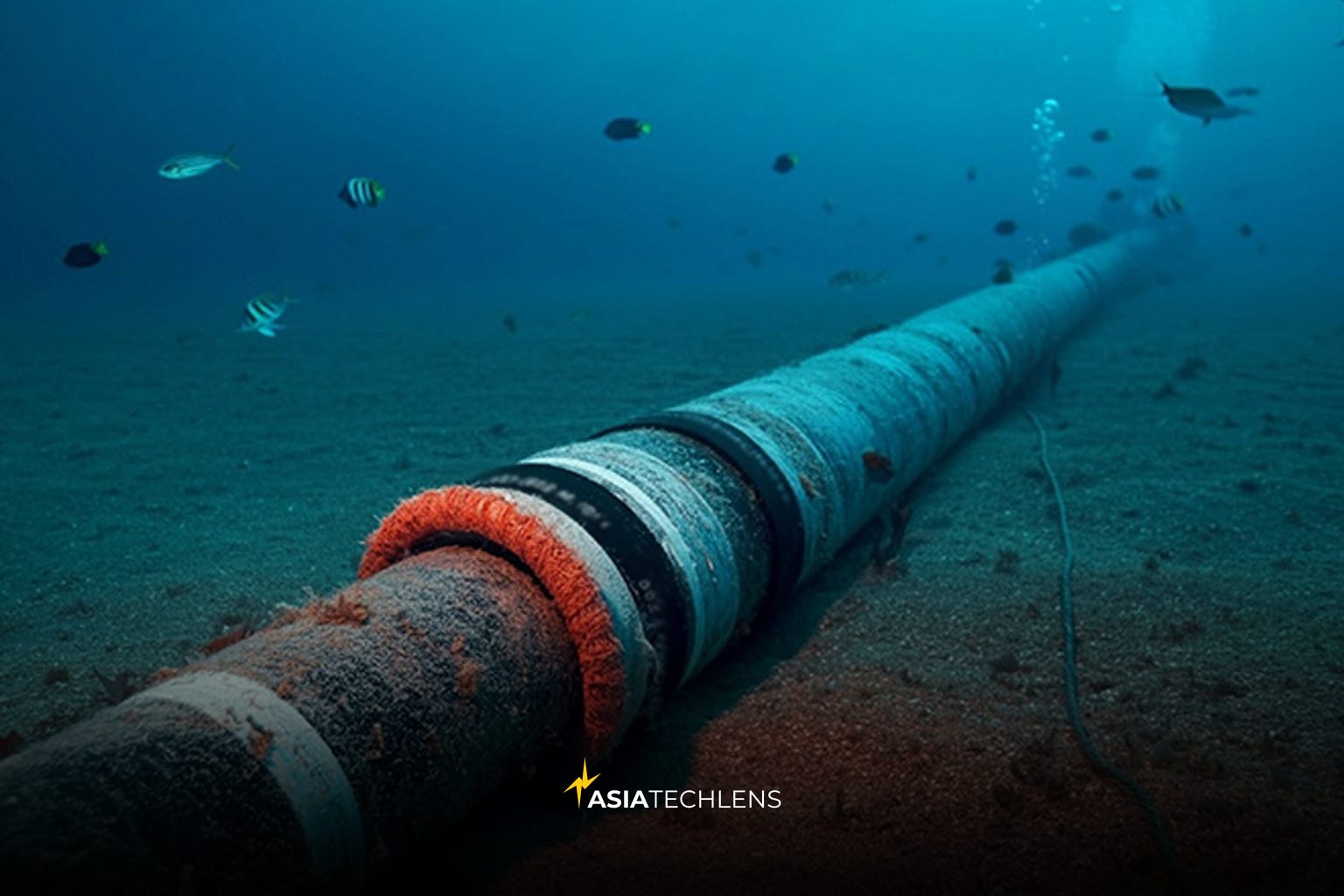
That shift is reshaping the physical internet that underpins Asia’s cloud and AI economy. As AI demand surges across Southeast Asia and the wider region, hyperscalers are ramping up investment in new subsea cable projects to support these new traffic patterns and reduce dependence on legacy routes.
Recent projects offer a glimpse of how this is playing out on the ground. New routes such as Google Cloud’s TalayLink, linking Australia and Thailand, and Meta’s Candle, spanning multiple Asian markets, show how hyperscalers are expanding and reconfiguring the subsea layer that connects their data centers across the region.
AI is pushing hyperscalers to treat subsea cables less like “internet plumbing” and more like strategic infrastructure linking data centers across Asia. Instead of simply buying capacity on legacy systems, they are increasingly helping design and fund new routes to lock in low latency, built-in redundancy, and greater resilience to geopolitical risk.
But the push comes with friction, from permitting delays and power constraints to tougher regulatory scrutiny over where and how cables land, tensions that could shape Asia’s AI connectivity for years to come.
AI-driven internet shift
For decades, Asia’s internet infrastructure was built around consumer behavior: people browsing websites, streaming video, and using apps hosted in large, centralized hubs. Traffic mostly flowed north–south, from users to servers, with latency that was good enough for consumer apps.
AI workloads place very different demands on the network. Training and running large models requires constant movement of data between data centers, often across borders, as datasets and model updates are shared between compute clusters. These flows are heavier and more sensitive to delays and outages than traditional consumer traffic.
As a result, legacy routes and capacity planning are starting to show strain. Networks optimized for entertainment and e-commerce were never designed to handle sustained, high-volume machine-to-machine traffic at this scale.
In short, AI exposes the limits of an internet built for people, not for machines running continuously across regions.
Why hyperscalers are investing
Demand for subsea cables is rising as hyperscalers race to support computation-heavy AI models and connect an expanding network of data centers across regions. Investment in new subsea systems is expected to reach about US$13 billion between 2025 and 2027, nearly double the amount committed between 2022 and 2024, according to telecoms research firm TeleGeography.
At their scale, relying solely on shared subsea infrastructure is no longer viable. Companies such as Google and Meta are increasingly backing or leading their own cable projects, not just by choice but out of necessity. Doing so gives them greater control over route design and landing points, while also helping them move faster and reduce delays tied to multi-party partnerships.
In an interview with CNBC, Meta’s vice president of network investments, Alex Aime, has said subsea connectivity is becoming a priority as AI scales, warning that data centers without strong connectivity risk becoming “really expensive warehouses.”
As content providers become the largest bandwidth users, many reach a scale where leasing capacity on existing cables no longer makes sense. TeleGeography says rising demand is pushing hyperscalers to secure capacity more directly by investing in new systems, reinforcing a shift that is expected to drive a surge in subsea spending through 2025–2027.
New hubs, new routes, and the geopolitics of AI connectivity
As hyperscalers take on a bigger role in designing subsea systems, the impact extends beyond investment. These choices are reshaping where cables land, which countries sit at the center of regional networks, and how risk is managed across borders.
Traditional hubs like Singapore, Hong Kong, and Tokyo are not being replaced. They remain central as control and interconnection points, even as new capacity and redundancy are layered around them.
What is emerging instead is a wider network of complementary hubs, shaped by practical constraints rather than market hype. Batam is increasingly used as an overflow and resilience play for Singapore, offering proximity without the same physical limits. Thailand is positioning itself as a new gateway between Australia and mainland Asia, while Indonesia and the Philippines are becoming harder to bypass as east–west routes routes thread through the archipelago. India and Japan, meanwhile, are being positioned as longer-term, scalable anchors, with growing cloud footprints and more predictable operating environments.
Their importance has less to do with ambition and more to do with whether they can support new landings, power-hungry data centers, and predictable permitting at scale.
Geopolitics adds another layer to these decisions. Routes are increasingly steered around sensitive chokepoints and regulatory risk, shaping the map in ways that prioritize resilience and maintenance access alongside distance.
Julian Rawle, associate partner for subsea at Cambridge Management Consulting, told Capacity Global that increased Chinese activity in the South China Sea has contributed to delays on major systems such as SJC-2 and introduced permitting challenges for projects seeking to transit the region without Chinese involvement.
As a result, developers are exploring alternative designs, from routes running south via the Java Sea to paths skirting the edge of China’s self-declared “nine-dash line” near the Philippines and Borneo.
In practice, this pushes cable planners toward routes and landing points that are easier to permit, maintain, and operate over the long term.
Japan, India, and parts of Southeast Asia often emerge as lower-risk landing zones for large Western hyperscalers, but that relative stability still comes with trade-offs, including more scrutiny, longer permitting timelines, and more complex cross-border coordination.
The stakes: path dependence in Asia’s AI connectivity
Projects planned and funded between 2024 and 2026 will shape Asia’s AI connectivity for the next decade. These investments interact with power grids, permitting regimes, landing stations, and regulation as part of a broader constraint stack that determines where AI infrastructure can realistically scale.
The outcome is unlikely to be a single backbone country. Instead, Asia’s AI infrastructure is taking shape as a corridor of interconnected hubs, with Singapore–Batam, Thailand, Indonesia, the Philippines, India, and Japan emerging as key nodes. Markets that cannot clear bottlenecks in power, permitting, and landing capacity risk being structurally pushed to the edges. And once cables land and ecosystems form, traffic patterns harden, and the map gets harder to redraw.