


In Plain English
A CPU and a GPU are two different kinds of computer chips. The CPU runs most of your computer’s everyday tasks like opening files, running apps, and managing instructions. The GPU is built to handle many similar tasks at the same time, which makes it faster for certain jobs like graphics, video, and AI.
CPU (Central Processing Unit): The All-Rounder
The CPU is often called the computer’s “brain” because it runs the main system and most everyday tasks on your computer.
It is best when work needs to happen step by step, in the right order.
A simple way to picture it: the CPU follows a cycle like fetch, decode, execute, store for instructions.
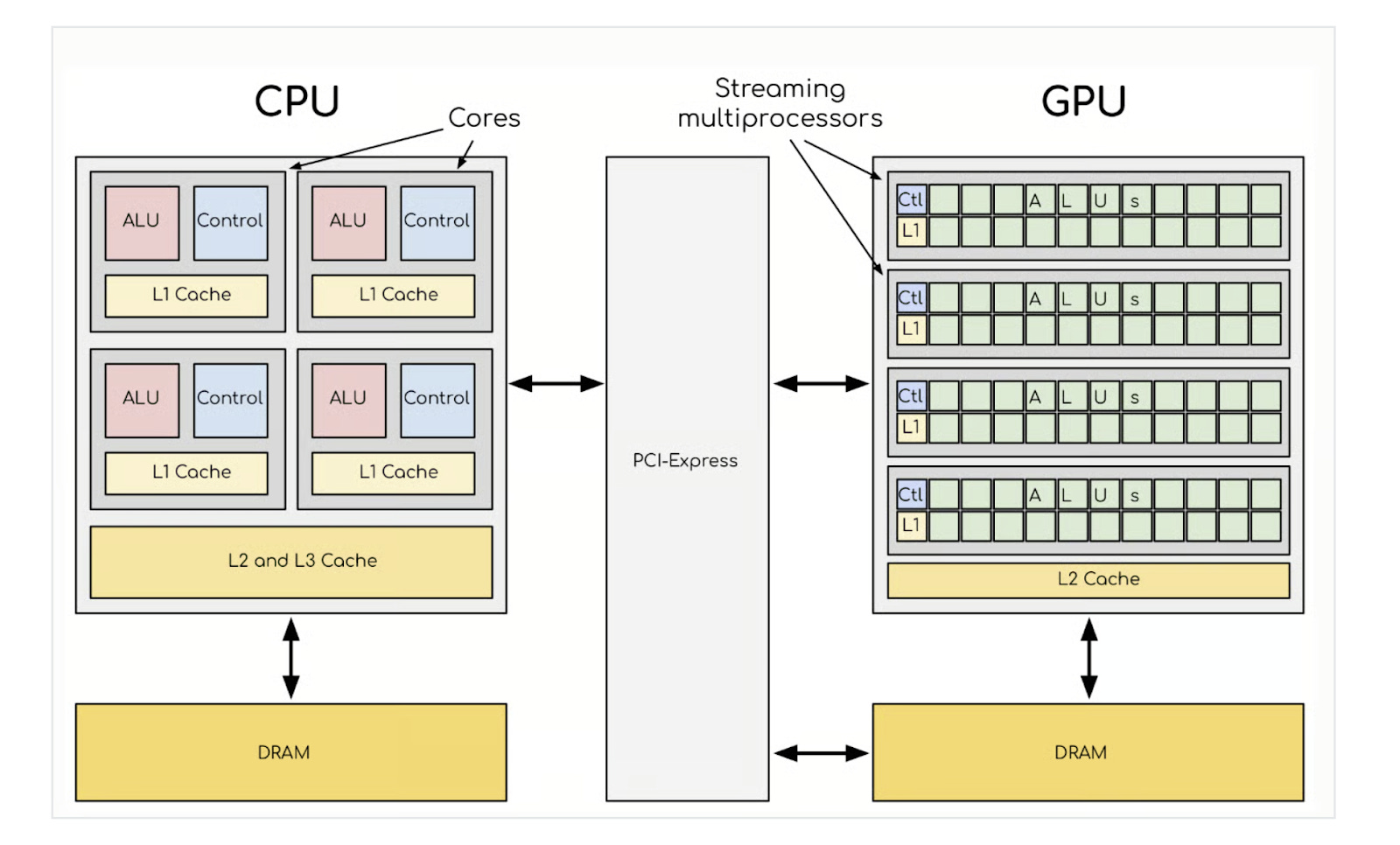
CPUs usually have fewer cores, which are the tiny “workers” inside the chip that follow instructions and run tasks, but each core is strong and good at branching logic, low-latency execution, and quick task switching..
GPU (Graphics Processing Unit): The Parallel Specialist
A GPU was first made to handle graphics, like drawing images in games and videos.
Has many more smaller cores than a CPU, sometimes thousands, so it can work on lots of similar tasks at once.
This makes it great for graphics, video, and AI, where the same kind of math is repeated over and over on large amounts of data.
Why It Exists
CPUs were made first to handle general computing tasks, like running the operating system and everyday programs. As games, video, and data-heavy apps grew more complex, computers needed extra power to process large amounts of data quickly. GPUs were created to take on these fast, high-volume jobs efficiently, especially for graphics and other workloads that can be split into many similar steps.
As graphics and high-performance computing demands grew, it made sense to design a chip that could do “the same calculation on a large grid of data” very efficiently. That is why GPUs evolved into powerful parallel processors, while CPUs stayed focused on being flexible and good at careful, step-by-step control.
Why It Matters
Today’s software is increasingly parallel by nature.
AI models, image processing, recommendation systems, and simulations all depend on repeating the same operations across massive datasets. GPUs make those workloads practical at scale.
At the same time, CPUs still matter deeply. System responsiveness, application logic, security checks, and orchestration all rely on fast, reliable sequential processing. In laptops, phones, and data centers alike, performance and power efficiency depend on using the right chip for the right job.
Common Misunderstanding
“A GPU is always faster.”
Only for highly parallel tasks. For small, branching, or decision-heavy workloads, a CPU can be faster and more efficient.
“More cores automatically means better.”
GPU cores are simpler than CPU cores. They win by working together, not by being individually powerful.
“You must choose CPU or GPU.”
Modern systems are designed around cooperation. CPUs coordinate. GPUs accelerate. The real gains come from using both correctly.