

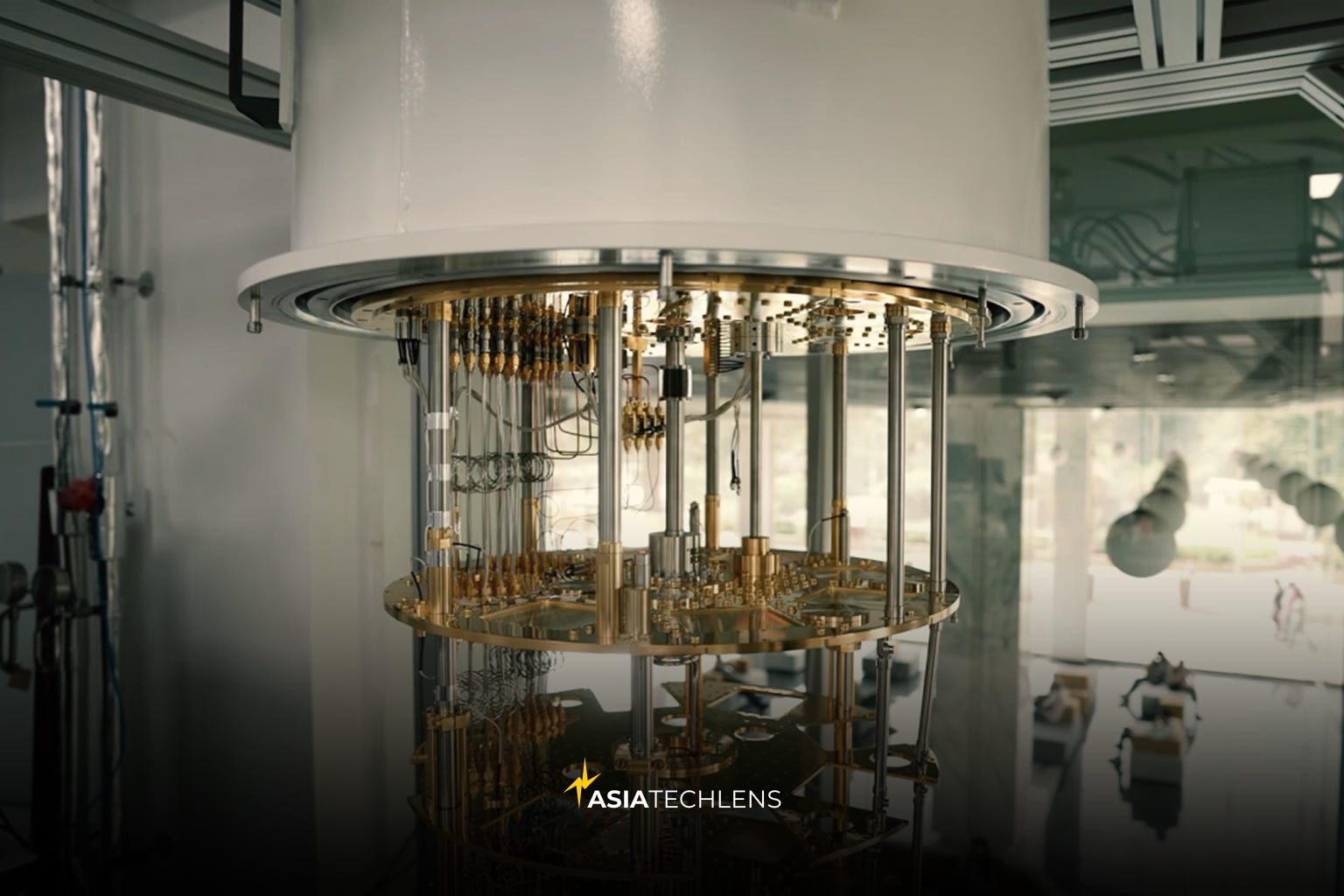
Quantum computing is a long-horizon, capital-intensive, physics-constrained race already being dominated by the hyperscalers—the likes of Google, IBM, and Microsoft. India is betting on a fledgling startup and a new ecosystem that is still underway. The ambition is real, but whether the country can escape catch-up mode is less clear.
Over the past year, India’s quantum industry has made numerous global headlines. In July, Bangalore-based deep tech startup QpiAI raised US$32 million in a round co-led by the Indian government. In November, the company unveiled a 64-qubit quantum processor, India’s most powerful to date, a notable progress from the 25-qubit quantum computer it launched in April.
The ecosystem for deep tech innovation is also looking promising. In September, a coalition of U.S. and Indian venture capital (VC) and private equity (PE) firms announced it is pledging more than US$1 billion to fund India’s deep tech startups over the next decade. Two months later, heavyweights NVIDIA and Qualcomm Ventures joined the coalition, signaling growing momentum.
But the already high bar continues being raised. It’s one thing to be a domestic champion and another to be a global contender. Can India carve out a name for itself in the global race for quantum computers?
For that, let’s see what the race looks like today.
Putting Things into Perspective
The first quantum computer was a 2-qubit system, built in 1998 by researchers from Oxford, MIT, IBM, UC Berkeley, and Stanford. Today, the technology has scaled to a point of surpassing the 1,000-qubit mark—IBM announced its 1,121-qubit quantum processor in 2023. As for India’s QpiAI, the company has created a roadmap to scale up to 1,000 qubits by 2030. It is already developing a 128-qubit processor.
If you’re wondering why qubit count matters: a higher count signals higher potential capability. In theory, it indicates that the quantum computer can handle more complex problems faster. This speed and capability distinguish quantum computers from conventional ones.
In an interview published in June, QpiAI founder and CEO Dr. Nagendra Nagaraja explained that in one of the simulations the startup ran, its quantum processor was able to complete a task that used to take 48 hours within 30 minutes—that’s 96 times faster. He added that 1,000 times faster computation is possible with quantum computers. For such computing power, quantum computers are heralded to bring a new era of more robust cryptography, financial systems, national security, and even drug discovery.
But qubit count alone is a misleading metric. What increasingly matters is not how many physical qubits a machine has, but how well they behave. For one, most quantum processors are known to get more error-prone as more qubits are added. This would consequentially hinder the system’s ability to run meaningful tasks. In that sense, a bigger quantum processor does not equal better machines.
Take Google’s Willow as an example. It’s a 105-qubit quantum processor. While the figure seems considerably small compared to IBM’s and not that far apart from QpiAI’s, Willow is making significant headway in error correction. If typically more qubits result in more errors, it’s the opposite for Willow—the more qubits used, the more errors are reduced. In a blog post, Hartmut Neven, founder and lead of Google Quantum AI, writes: “Willow brings us closer to running practical, commercially-relevant algorithms that can’t be replicated on conventional computers.”
For an Indian company to make a name in today’s quantum race, it’s not enough to be quantitatively bigger, it needs to be qualitatively better.
QpiAI’s Bet on Systems
There is no shortage of ambition for QpiAI. The company is creating solutions that combine quantum with AI, and it is building full-stack—it’s building quantum hardware, software, and applications, while integrating AI into the system. For a late entrant with limited capital compared to hyperscalers, this is a bold and risky strategy.
When asked in an interview published in August whether the company is doing too many things, CEO Nagaraja responded, “Not at all”. If you’re building a system company—an interconnected whole and not just one hero product—you have to do whatever is required, Nagaraja implied.
This approach has clear advantages. A full-stack model concentrates learning, allows faster iteration, and avoids dependence on external platforms controlled by global incumbents. It also creates nearer-term commercial pathways, particularly important in a field where pure hardware bets can take a decade to pay off. This approach has paid off commercially. QpiAI has been EBITDA-profitable for the past three years, Nagaraja told Tech Crunch.
But the trade-offs are significant. Full-stack development stretches scarce talent and capital across multiple fronts at once, potentially diluting focus and slowing per project progress.
It’s a good thing there is more support now than ever.
A New Future for Quantum
Quantum players in India like QpiAI are finding themselves at a time where policy and access to capital converges.
On the public front, India now runs the National Quantum Mission, an 8-year initiative launched in 2023 to create a quantum ecosystem in the country, with US$750 million worth of capital at its disposal. QpiAI’s latest fundraising round saw participation from the National Quantum Mission, signalling the government-run initiative’s commitment to back young startups.
The country is also building the Quantum Computing Village, a 50-acre hub for quantum research, innovation, and collaboration in Amaravati. Reports say the site will be launched by January 2026.
On the private capital front, the aforementioned US$1 billion being pledged by the U.S. and Indian VC-PE alliance suggests an influential global linkage being formed. Deep tech startups in India will not only benefit from access to capital, but also mentorship and network. While this does not guarantee competitiveness, it’s a welcome change.
India’s quantum push is no longer theoretical. The startups are in build-mode, capital is being made available, the government is paying close attention, and the world is watching its quantum development. Yes, there is plenty of homework: from solving physics and engineering questions to talent bottlenecks. But there is real momentum and homegrown players are beginning to narrow parts of the distance with the incumbents.
The question is whether they can still remain relevant by the time the goalpost shifts again.