


Asian enterprises are buying AI middleware to reduce model lock-in. But in regional deployments, that flexibility can create a harder dependency: jurisdictional control.
Before choosing a middleware platform, tech leaders should ask one question first: can this layer control and prove where data moves by jurisdiction, data type, business unit, and risk level?
In June, China’s Ministry of State Security warned domestic organizations about third-party “AI relay” services used to access foreign AI models. The warning was aimed at intermediary platforms that make foreign models easier to reach, but may also obscure what happens to the data passing through them.
That should not be read only as a China story. It’s an early warning about a broader enterprise problem across Asia: the layer that promises model flexibility can also decide where data moves, what gets logged, which fallback provider is used, and which jurisdiction governs the workflow.
That shift changes the lock-in question.
The Governance Layer Is Harder to Replace
Enterprise AI buyers often think lock-in begins with the model. If they build on OpenAI, Anthropic, Google, DeepSeek, or another provider, they worry that switching later will be difficult. But in a middleware-led architecture, the model may be the easier part to change.
A platform such as OpenRouter, for example, lets developers access many models through a single interface rather than integrating with each provider separately. That makes it easier to test, switch, or combine models as performance, pricing, and availability change.
However, the more important dependency isn’t the model endpoint. It’s the governance layer above it.
That layer can include model gateways, cloud AI platforms, API routers, orchestration tools, guardrail systems, observability layers, and vendor-built connectors into internal systems. Together, these tools do more than pass prompts to models. They shape how AI is routed, monitored, logged, governed, and connected to the enterprise.
If the enterprise standardizes around it, the lasting lock-in may not be to any single model. It may be to the system that manages access to all of them.
The model can change. The governance layer is harder to unwind.
What the Middleware Actually Controls
The mistake is to treat that layer as a neutral pipe; it’s not.
Middleware can decide where a request goes, which fallback provider handles it, what gets logged, and which internal systems the AI tool can access. It can also shape governance by redacting sensitive data, classifying requests, or blocking responses.
In other words, it becomes the operational layer through which AI is governed, and one the board, legal team, and regional operators may not fully understand until it’s already embedded.
Why Asia Makes This Dangerous
Middleware risk matters in any market. In Asia, it is harder to manage because regulation is fragmented. The same AI workflow can be treated differently across Singapore, China, and Indonesia depending on the data, industry, recipient, and transfer path.
Consider a regional bank deploying an AI-powered customer-service assistant across those three markets. The business goal is straightforward: help agents summarize customer issues, draft responses, search internal policies, and escalate complex cases more quickly.
To streamline rollout, the bank adopts a middleware platform that connects its internal systems to multiple AI models through one interface. From the product team’s perspective, this is efficient: one workflow, one integration, one operating layer.
But that single operating layer may be doing far more than the business realizes. It may route low-risk requests to a cheaper model, escalate complex prompts to a more capable provider, store prompt histories for monitoring, generate audit logs for compliance teams, and connect the AI assistant to customer records or internal knowledge systems.
From an operational perspective, the workflow looks standardized. The same tool helps agents respond faster across markets. The same middleware layer manages access to models. The same business function is being supported.
From a regulatory perspective, there may be three different realities.
In Singapore, the issue is whether comparable protection and overseas transfer visibility can be demonstrated. The bank needs to understand not only the model provider, but also whether prompts, logs, metadata, and outputs are being transferred or retained by another party overseas.
In China, the issue is whether the middleware accidentally creates an unapproved outbound transfer path. If the platform routes from China to overseas infrastructure, the bank may have created a cross-border data flow that was never clearly approved as part of the AI procurement decision.
In Indonesia, the issue is whether the enterprise can prove adequate protection across controllers, processors, logs, routing systems, and model endpoints. For an AI workflow routed through an intermediary, the company needs to know where each part of that chain sits and under whose control.
This is the part many AI procurement discussions miss. The real compliance question is not only which model is approved, but whether the enterprise can control and prove where prompts, outputs, logs, and fallback routes actually go.
One standardized AI workflow may be acceptable in one jurisdiction, require additional safeguards in another, and become unworkable in a third. The workflow looks standardized to the business, but it is not standardized to the law.
That gap is where jurisdictional dependency forms.
What Tech Leaders Should Audit Before They Commit
For Asian tech executives, the middleware decision should move earlier in the governance process. Before asking which model performs best, operators should first ask which layer will control the flow of data once the system is live.
The audit does not need to start with dozens of technical questions. It should start with five executive questions.
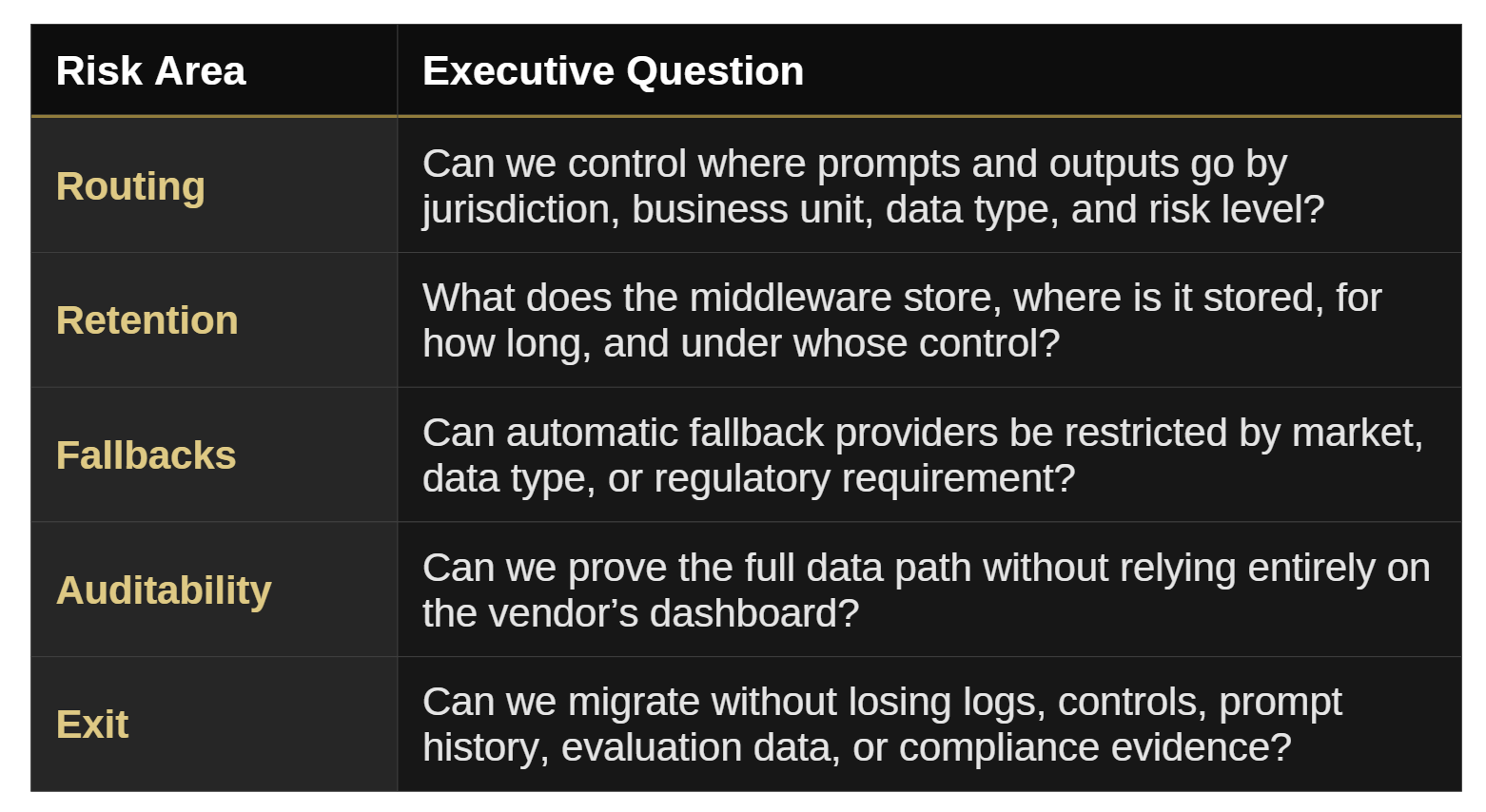
These are not edge-case questions; they’re procurement questions.
They determine whether middleware remains a flexible access layer or becomes a dependency the company cannot easily unwind.
The Trap Is Treating Middleware Like A Shortcut
Asian enterprises will need AI middleware for cost control, model flexibility, monitoring, fallbacks, guardrails, and centralized governance. The mistake is not adoption; it’s treating a core infrastructure layer like a convenience tool.
This pattern is familiar. Infrastructure dependencies often become strategic before organizations recognize them as such. AI middleware can create a similar dynamic, but with an added regulatory layer.
Once the organization builds its AI workflows around a middleware platform, switching later may not mean simply changing API endpoints. It may require rebuilding audit trails, revalidating compliance controls, changing data-processing agreements, reworking logging architecture, reconfiguring guardrails, retraining internal teams, and proving to regulators that regional data flows remain compliant.
The operational consequences are not theoretical. A company may need to disable a workflow in one market, split a regional deployment into country-specific versions, renegotiate vendor terms, rebuild compliance evidence, or migrate away from a platform after teams have already built around it.
That’s not only vendor lock-in in the software sense; it’s also jurisdictional lock-in.
The company becomes dependent not only on a vendor, but on the routing, storage, retention, and compliance assumptions embedded in that vendor’s architecture.
The Executive Decision
AI middleware is not just a technical layer for platform teams to manage. For enterprises operating across Asia, it is becoming a governance, compliance, and regional operating model decision.
That means the buying process has to change. Legal, risk, data protection, and country teams should be involved before the middleware layer becomes the default path for AI workflows.
The question is no longer only whether a platform can connect the enterprise to more models. It is whether the enterprise can still control the legal and operational architecture once that platform is embedded.
The Buying Rule
Enterprise AI in Asia will be sold as flexibility: use any model, switch anytime, route intelligently, reduce costs, and centralize governance. But flexibility only matters if the enterprise can still control the layer making those decisions.
Before buying, leaders should ask whether the vendor can show where data goes, what it stores, how fallbacks are restricted, how audit evidence can be exported, and how the enterprise can exit.
If the answer is unclear, the company is not buying flexibility. It is buying the vendor’s routing logic, retention choices, compliance assumptions, and jurisdictional exposure.
That is the buying rule: do not treat middleware as a convenience layer unless it can survive legal, risk, and country-level scrutiny.
The model can change. The jurisdictional dependency often remains.
Go Deeper on Asia Tech Lens
iOS Is No Longer a Global Security Baseline. Enterprise IT in Asia Needs to Act Like It.
Regulatory unbundling in the EU, Japan, and China is turning iOS fleet management into a jurisdiction-by-jurisdiction problem. The same pressure is now coming for AI middleware, where global defaults can quickly collide with local rules on data, security, and control.Vietnam’s 5G Is Expanding Fast. Can Operators Trust the Stack It’s Built On?
Vietnam’s 5G rollout shows how vendor-stack choices can create compliance, interoperability, and switching risks long before operators realize they are locked in.A Quiet Alliance: The Hidden Layer Powering AI Adoption in Asia
AI adoption often depends less on headline models than on the partners and intermediary layers that turn platforms into real deployments.The AI Agent Era Has Begun, and Privacy Risks Are Rising
As AI systems move from answering questions to acting inside workflows, privacy, access control, logging, and oversight become core deployment risks.Invisible Arteries: Subsea Cables in the Age of AI
A broader infrastructure read on why the systems beneath AI adoption matter.