

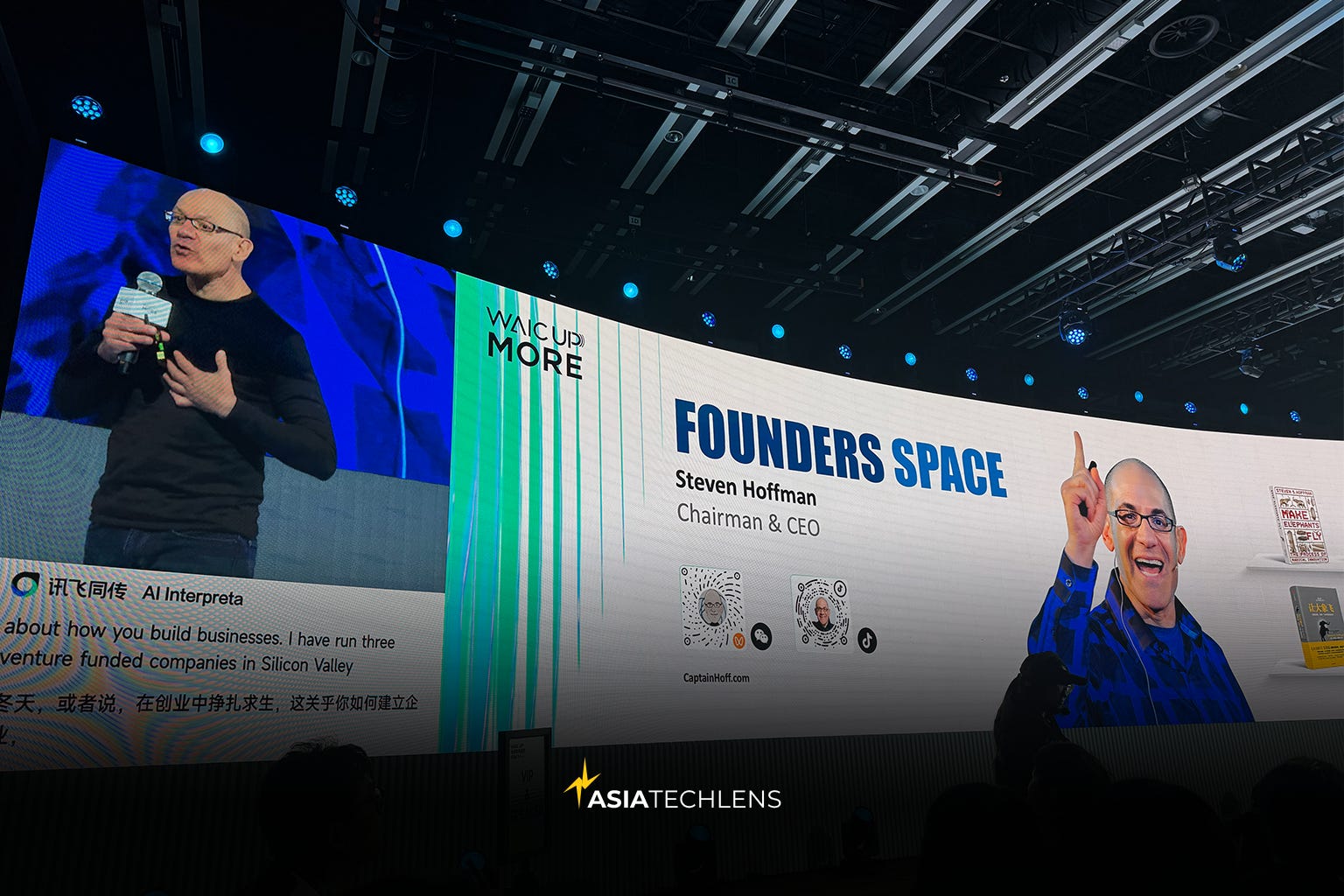
Editor’s Note: Asia Tech Lens’ editor-in-chief Miro Lu attended the 2026 WAIC UP! Global Summit in Hong Kong on 16th January 2026, where a recurring theme in panels and side discussions was that the “first wave” of generative AI is giving way to a more operational phase defined by distribution, monetization, and platform strategy.
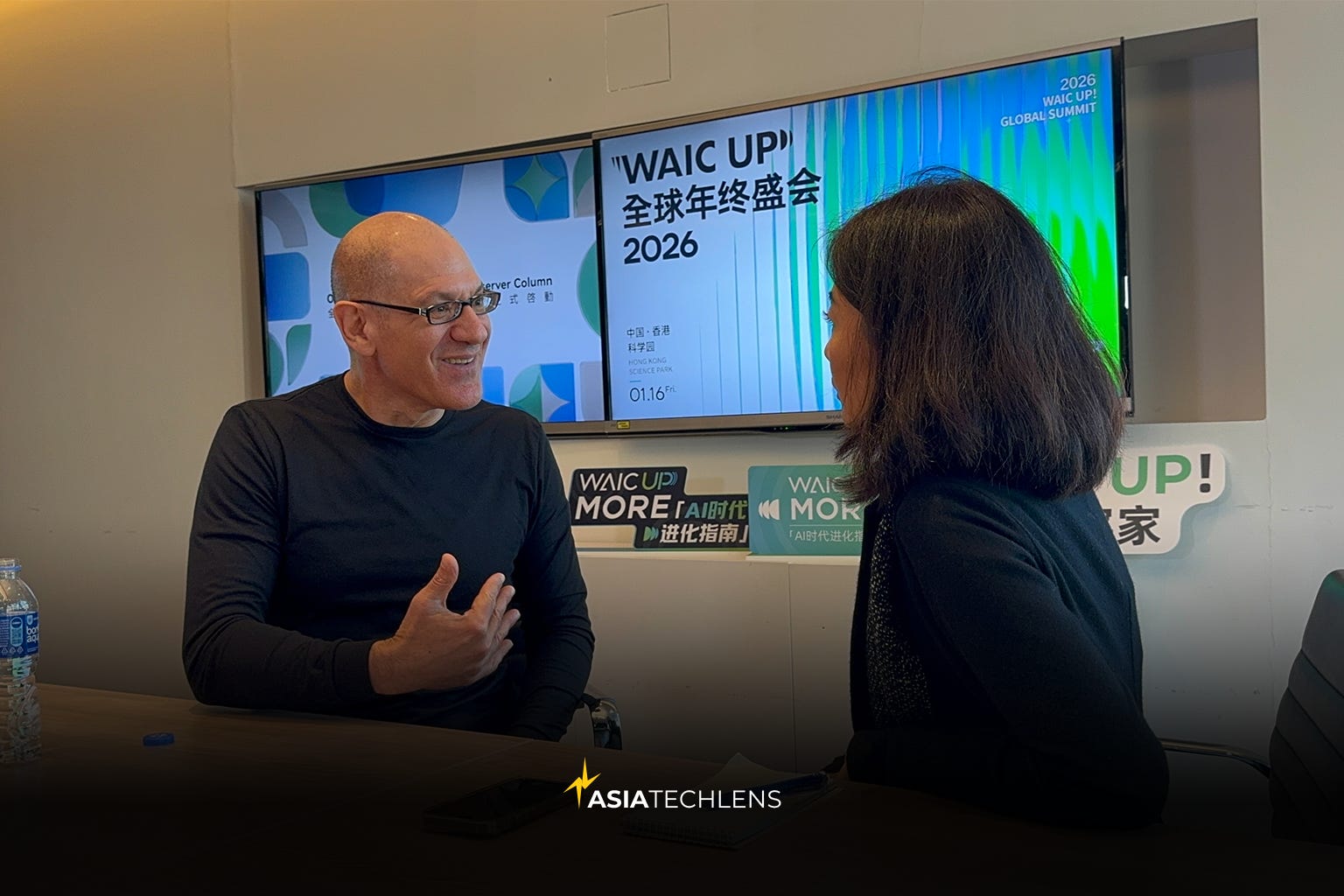
On the sidelines of the event, Miro spoke to the Chairman & CEO of Founders Space, Steven Hoffman, who has worked across Silicon Valley’s venture and accelerator ecosystem, and who now leads the Captain’s Future Foundation, a non-profit focused on preparing young people for leadership in the AI era. Hoffman shared the shifts he is seeing across the industry, from how AI products are being built and distributed to how companies are thinking about scale, competition, and the next stage of growth.
This piece is based on their conversation and reflects Hoffman’s analysis and forecasts.
Monetization Moves To The Consumer
“Initially, most of the revenue was being generated B2B. We’re moving into a different era now. We are shifting now to actually monetizing consumers.”
Hoffman’s first point is that AI’s early money was not about consumers. The bulk of revenue came from businesses, with enterprise adoption doing the heavy lifting. Even within that B2B phase, he flags coding as the clearest revenue engine so far. He uses Anthropic as an example of what that looks like in practice, pointing to the fact that the majority of its revenue comes from coding applications built on its API.
What changes in the next phase, he argues, is that the category has to be packaged for everyday users, not just sold as a productivity layer to companies. He sees ChatGPT’s push toward commerce-adjacent use cases, “embedding e-commerce and other things,” as he puts it, as a sign that the center of gravity is moving closer to transactions and repeat consumer behavior.
But he is blunt about the constraint: most people prefer free. In his view, consumer willingness to pay remains limited outside a subset of power users. In the U.S., he argues the paying customer is still more often a business user than an average consumer. He draws an even sharper contrast with China, where he says consumer payment is rarer still.
That gap matters because the financial expectations around the leading AI companies are now too large to be carried by enterprise contracts alone. He argues that if OpenAI heads toward an IPO, it will have to justify the story not just through adoption, but through revenue growth.
The Ecosystem Battle
“It’s the battle for the biggest, best, most valuable ecosystem that attracts the most enterprise customers, the most developers and the most consumers.”
Hoffman argues the next phase of AI is an ecosystem war. The goal is not to win with dozens of standalone apps, but to become the default platform that developers build on, enterprises standardize on, and consumers return to daily.
In the U.S., he puts OpenAI and Google in the lead going into 2026. In his view, OpenAI still dominates consumer adoption, while Google has been “closing the gap” by shipping AI across a broader product surface, including its Gemini stack and adjacent tools. Below that tier, he treats the rest as catch-up. He calls xAI behind, and frames Microsoft as a disciplined operator that must accelerate its own model development as OpenAI starts to look less like a partner and more like a future competitor. He is harshest on Apple, arguing it “dropped the ball on AI” He praises Tim Cook as an operations leader, but not a visionary, and points to Apple adopting Gemini “in place of Siri” as a sign of how far it has slipped by not building its own LLM.
He sees a similar platform fight playing out in China, but with different structural advantages. He names four major players, Doubao, Kimi, Qwen, and DeepSeek, and argues Alibaba is well-positioned because it can pull multiple ecosystem levers at once, including cloud infrastructure, chips coming online, and commerce businesses that generate data at scale. He describes Kimi as innovative, ByteDance as formidable, and DeepSeek as a breakout that now faces the harder task of consumer mindshare as competition intensifies.
The through line in his argument is that the winning AI companies will not only train capable models. They will wrap those models in a platform, with distribution, developer tools, and infrastructure that makes it costly for users and builders to leave.
Two Tech Stacks, One Buyer Decision
“It depends on the application. If you’re just running an app and you need AI to do some stuff, it doesn’t make a difference, so they’re (buyers) going to go to the cheaper option.”
With that platform race as the backdrop, he shifts to what builders in third markets are already grappling with: when you are looking at the U.S. and China stacks side by side, how do you choose?
Hoffman frames the emerging market as a buyer decision more than an ideology. When the application is high stakes, he argues customers will pay for the best model because the cost of failure can exceed the savings. Coding is the simplest example. Bad code can cause defects, introduce security issues, or waste engineering time, so quality has a direct financial downside.
For the long tail of everyday applications, he argues the quality gap is often harder to notice. That is where price dominates. He claims Chinese models can be dramatically cheaper to serve, sometimes one-tenth the cost or less, and once a product operates at scale those economics become difficult to ignore. If outputs are close enough for the job, the cheaper stack wins on unit economics.
He links this cost wedge to monetization. If consumer willingness to pay is lower in China, he argues, platforms have to find revenue elsewhere, including overseas usage by developers and enterprises that prioritize cost-effective performance at scale.
His broader takeaway is that a two-stack market does not force a single winner. It creates segmentation. Premium models take the highest-liability workflows, while lower-cost models capture the bulk of applications where “good enough” plus low serving cost is the winning product strategy. For builders in Southeast Asia and other third markets, that translates into a pragmatic architecture choice: use premium models where accuracy and risk matter most, and route everything else to the cheapest model that meets the specification.
Manus And The Signal It Sends
“This is not a trend the Chinese government wants, because it’s not, it’s not in line with policy. It’s not good for China’s growth and economy.”
Hoffman points to Manus as an example of how the “two-stack” debate becomes governance. Manus, a China-rooted AI agent startup, was reportedly acquired by Meta, a deal that has triggered scrutiny in China over technology export controls and the cross-border movement of talent and IP.
The scrutiny, he argues, is about precedent. If founders set up offshore, keep teams in China but shift “all the IP” outside, that becomes a pattern policymakers want to discourage. He frames it as an open question whether the government blocks it to “set the example,” or lets entrepreneurs take the opportunity.
He then widens the lens. Chinese founders are already behind many major AI startups abroad, and he does not see that stopping. And he argues an overseas exit is not automatically a loss for China, because a lot of that capital flows back through reinvestment and hiring. He even puts a rough split on it: “80% is probably going back into the Chinese ecosystem,” with “only 20%” going elsewhere.
Ambient AI And The Next Interface
“What these AI companies want to do is they don’t just want the data you put in your phone. They want all your data. And they want to take all this data and use that to actually guide you through your life.”
Hoffman’s forward-looking bet is what he calls “ambient AI,” assistance that runs continuously in the background and uses context to guide you through daily life. In his framing, the shift is from a chatbot that waits for prompts to a system that anticipates needs based on what you see, where you go, and what you say.
That ambition, he argues, changes the data equation. The value is no longer only in what a user types, but in the surrounding signals that make the system useful without being asked. He also implies the inevitable tradeoff. A tool that “knows” more can be more helpful, but it also raises harder questions about consent, privacy, and how much continuous collection regulators and consumers will tolerate.
In practical terms, he imagines a world where the assistant is present throughout the day. You walk into a meeting and relevant material is surfaced automatically. You leave and a clean summary is generated and sent where it needs to go. The point is not novelty. It is removing the friction of having to ask.
The open question is what device becomes the default for that assistant. Hoffman’s rule of thumb is behavioral. It is hard to change daily routines, so the winning form factor has to fit the habits people already have. He is skeptical that bulky headsets become mainstream, and he treats even smart glasses as a harder sell than many assume.
That is why he keeps coming back to earbuds. People already wear them, and they offer a low-friction channel for an assistant that can listen and speak throughout the day. Over time, he suggests, that channel could expand with additional sensors that add context, without requiring users to adopt an entirely new device category.
Beyond earbuds, he describes himself as a believer in brain-computer interfaces as a longer-term horizon. His core message is straightforward. The next interface will not be another app. It will be a layer that sits with the user all day. As Hoffman puts it, whoever wins that ambient layer wins the next ecosystem.
If Hoffman is right, the second phase of AI will look less like a model arms race and more like a distribution contest. Consumer monetization forces the shift, ecosystems decide the winners, and a two-stack market turns procurement into strategy. Ambient AI is the endgame, because the interface that follows you all day is the platform you stop leaving.
Related Reading On Asia Tech Lens
If this piece resonated with you, these might be of interest as well:
The Dependency Economy of AI: Sovereignty, Chips, and Global Chokepoints
Why only full-stack ecosystems can claim real AI sovereignty, and how dependence shows up through chips, cloud, and model accessWhy ByteDance’s AI Phone Hit a Wall: Security, Fair Play, and the Economics of Attention
A case study in why phone-level agents collide with platform trust controls once they start “doing,” not just “suggesting.”
The AI Battleground: How Southeast Asia Is Forging a New US–China AI Frontier
How Southeast Asia is mixing open and closed approaches pragmatically.Why Superhexa Is Rethinking AI Glasses
A form-factor reality check on ambient AI, focused on comfort, battery, and why wearables only win when they fit daily habits.China’s Bet on Domestic Tech: The Companies Poised to Gain Amid Rising Tariffs
How U.S. restrictions are accelerating China’s self-sufficiency push, and which domestic champions stand to gain across the AI supply chain.