

China’s consumer AI race is moving into its most visible battleground of the year. Chinese New Year is no longer just a holiday window, it is a live-fire test for the biggest platforms to prove product strength in front of a mass audience, and to do something less glamorous but just as important: teach users what these tools are for. DeepSeek’s breakout last year raised the tempo and this year is being treated as a distribution sprint.
Alibaba has signaled a holiday push for Qwen, Baidu is promoting Ernie, and ByteDance is positioning Doubao for peak-season attention. Tencent is reaching for a playbook it knows works. The Chinese social media and gaming giant behind WeChat and QQ is trying to recreate its 2015 breakthrough, when a Spring Festival red packet blitz helped turn WeChat Pay into a mass habit almost overnight. This time, it is using the holiday window to push its AI assistant app, Yuanbao.
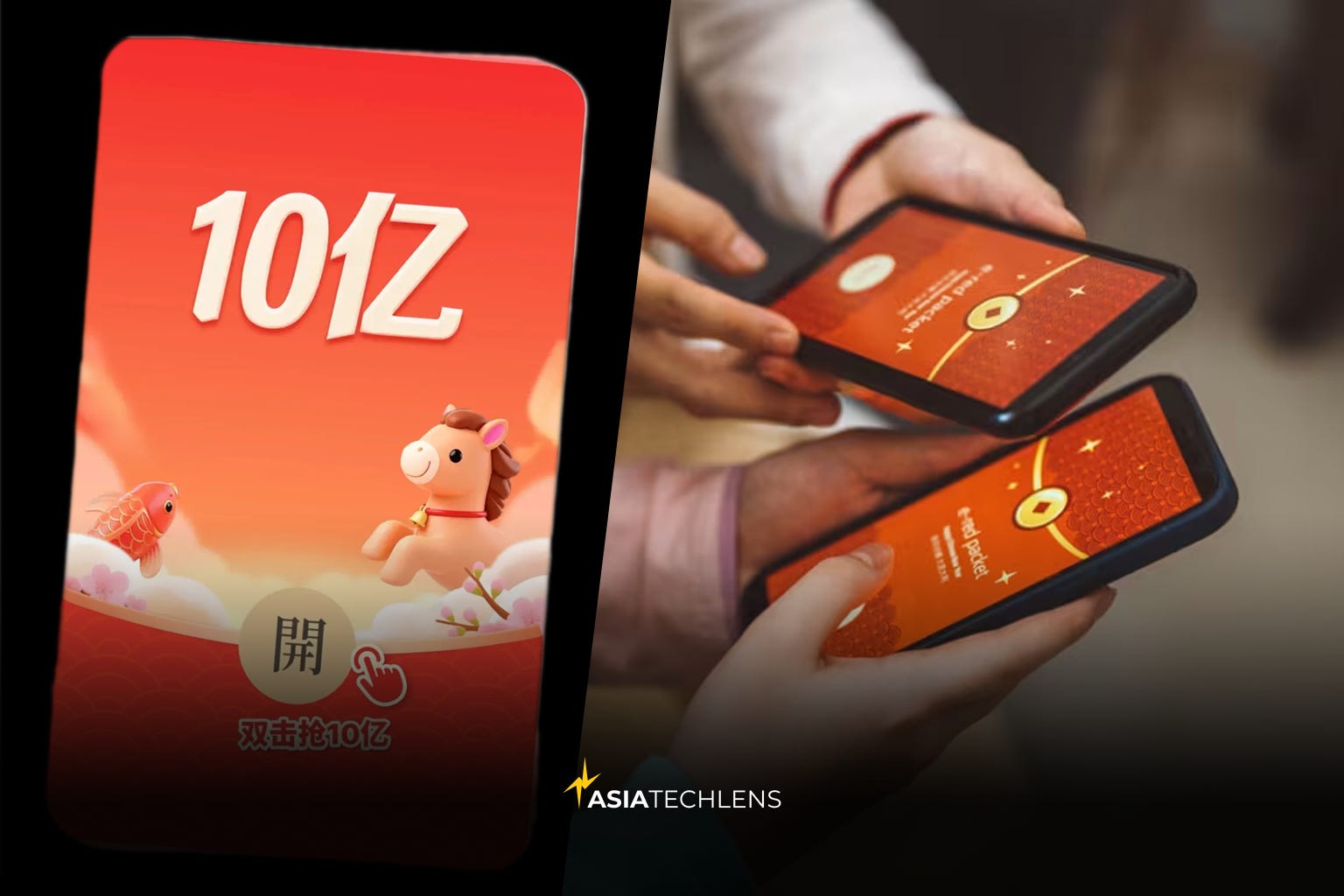
This push is twofold. The first is a Spring Festival red packet campaign worth RMB 1 billion (about US$140 million), structured around daily cash packets and task-based draws, with a small pool of larger prizes worth up to RMB 10,000.
Second, and more strategically important, is Yuanbao PAI: Tencent’s new group feature inside its Yuanbao AI app. Think of it as an “online party”, a shared room rather than a chat thread: you create or join a PAI, and the AI sits inside as a participant. Inside PAI, the assistant is designed to support shared routines, from synced watching and listening to practical group utility like timed info drops, quick fact-checking, and lightweight recaps of what the group has been discussing, alongside creative tools like simple image edits and style changes that can be generated and shared in-room. The beta is currently limited to domestic users.


That pairing, cash distribution plus a group product surface, is what makes the announcement worth watching. Steven Hoffman, the Chairman & CEO of Founders Space, who tracks platform strategy in China, describes it as a “smart, strategic move” with Tencent going on the “offensive” in consumer AI.
For Hoffman, the bet is not just that people will try Yuanbao during the holiday surge. “Tencent isn’t just looking for a spike in usage on Yuanbao. It wants to change consumer behavior,” he said. “Tencent knows that during the Spring Festival, people are more open to adopting new apps and trying them out.”
Tencent is also leaning on the way Spring Festival coordination already runs through its own ecosystem. “Tencent also knows that during the Spring Festival, people are coordinating and collaborating with all their family members,” Hoffman said. This creates a natural invitation loop if Tencent can tie Yuanbao participation to existing WeChat-mediated family coordination.
Why Tencent Built ‘PAI’ Outside WeChat
The most revealing part of this launch is what Tencent is not doing. It is not dropping Yuanbao into existing WeChat group chats as a visible participant. Instead, it has ringfenced the experiment inside Yuanbao, in a separate group space where PAI runs by its own rules.
That separation matters for several reasons. WeChat and its group chat feature are Tencent’s core social infrastructure. Groups are where families coordinate plans, friends organize life, and everyday logistics get settled in real time, which is why even small interface changes can create outsized friction.
“What I’ve seen play out in the United States is that in these group chats, people don’t really want AI interfering. They don’t want AI taking a lead role.”
That is why Hoffman views Yuanbao PAI as a bridge rather than a forced redesign. In his view, “people don’t want AI pushed on them. They want to adopt AI.” When companies try to “shove AI in people’s faces inside applications,” it can make those products “less functional or less attractive,” because users already have an established way of doing things. “In fact, the AI may end up making WeChat groups less attractive instead of more attractive,” he adds.
Structurally, this fits Tencent’s dual-track approach. Keep WeChat stable. Use Yuanbao as the native, experimental AI surface. PAI is the clearest attempt to connect the two without risking a backlash inside Tencent’s main chat product.
As Hoffman puts it, “the Yuanbao application is a place where Tencent can experiment… without risking damaging the carefully crafted WeChat experience.” Inside Yuanbao, Tencent can push a more “AI-in-the-room” model and see how people actually use it in groups, from how often they tag the AI to which features create repeat behavior rather than novelty. If the experience turns out to be noisy, awkward, or simply not sticky, the downside is contained to a separate surface rather than spilling into the chat product people treat as everyday infrastructure.
AI + Social: Why This Matters, and Why WeChat Is The Advantage
Tencent’s advantage is distribution. WeChat sits on one of the largest social ecosystems globally, reporting 1.414 billion combined monthly active users (Weixin + WeChat) as of September 30, 2025.
That is why ‘AI + social’ is the higher-stakes bet. A standalone chatbot is useful but optional. You open it for an answer, then leave. Social is where habits live. If AI is pulled into group routines, it stops being a tool you visit and starts shaping how people coordinate, decide, and move. That is what Tencent is testing with Yuanbao PAI, which is built for multi-person use, not solo prompting.
As Hoffman puts it, “the big advantage of Yuanbao PAI is that it is literally injecting AI into the space where people live, communicate, socialize, and do everything they need to get done.” He adds that “whether it’s about work, pleasure with family members, this puts AI at the center of it.”
The commercial logic follows. The upside is not AI ‘chatting’, but AI reducing the friction inside human interaction: threads that sprawl, decisions that get buried, work chats that stall, family groups that fragment, communities that lose momentum. A group AI layer can earn repeat use by summarizing, organizing, and nudging, while keeping the space alive with lightweight outputs like recaps and meme generation.
PAI’s early feature set points to the same loop. ‘Watch Together’ and ‘Listen Together’ are designed to turn shared media into a repeatable group routine, backed by Tencent’s content ecosystem and the audio-video stack built for Tencent Meeting. If that loop works, the win is not a holiday spike. It is AI becoming the default because it sits in the middle of what people are already doing.
The harder test is fit. It is easy to bolt features together; it is harder to make the AI feel native to the moment, helping without forcing users to “operate” it. If PAI works, it will be because the assistant knows when to summarize, when to stay quiet, and when to move the group forward.
Hoffman is bullish, arguing that if “Tencent executes well with Yuanbao PAI and with integrating AI into the WeChat ecosystem, it has a chance to become the number one AI application in the future.” He also flags the risk. In group chats, AI can feel intrusive fast. People are there to talk to each other. If the model gets pulled in too often, it clutters the thread and drains what makes the conversation feel real.
If Tencent gets PAI right, it will not be because it shipped the most features or spent the most on red packets. It will be because it found a workable social contract for AI in groups: useful enough to reduce friction, quiet enough to keep the conversation human, and integrated enough to feel like flow.
That is the real Spring Festival test. The holiday can drive trials. WeChat can drive invitations. Retention depends on whether PAI still has a job once the cash incentives fade.
Related Reading On Asia Tech Lens
Why Southeast Asia’s Super Apps Won’t Look Like China’s
Why WeChat-style dominance is hard to copy, and why distribution in SEA looks more fragmented, regulated, and competitive.Fewer Apps, More Utility: How Mini Apps Are Changing Digital Life in Southeast Asia
How “apps inside apps” lower friction, and why ecosystems win when users do not want another download.Virtual Partners, Real Markets: The Rise of AI Companions
Why AI gets sticky when it becomes part of social and emotional routines, not just a tool for answers.AI for Global Equity Begins With Local Realities
Why the hardest AI problems are trust, language, and deployment, and why “responsible” starts with real user constraints.Thailand’s Digital Transformation
A ground-level look at how platforms, payments, and infrastructure shape adoption, and how China-linked tech shows up in everyday systems.
Thanks for writing this, it clarifies a lot, and I'm just so full of wonder imagining how Tencent's briliant PAI strategy will reshape how we interact with AI in our daily social lives.
Does anyone disagree with the strategy of keeping PAI in Yuanbao rather than forcing it into WeChat?