

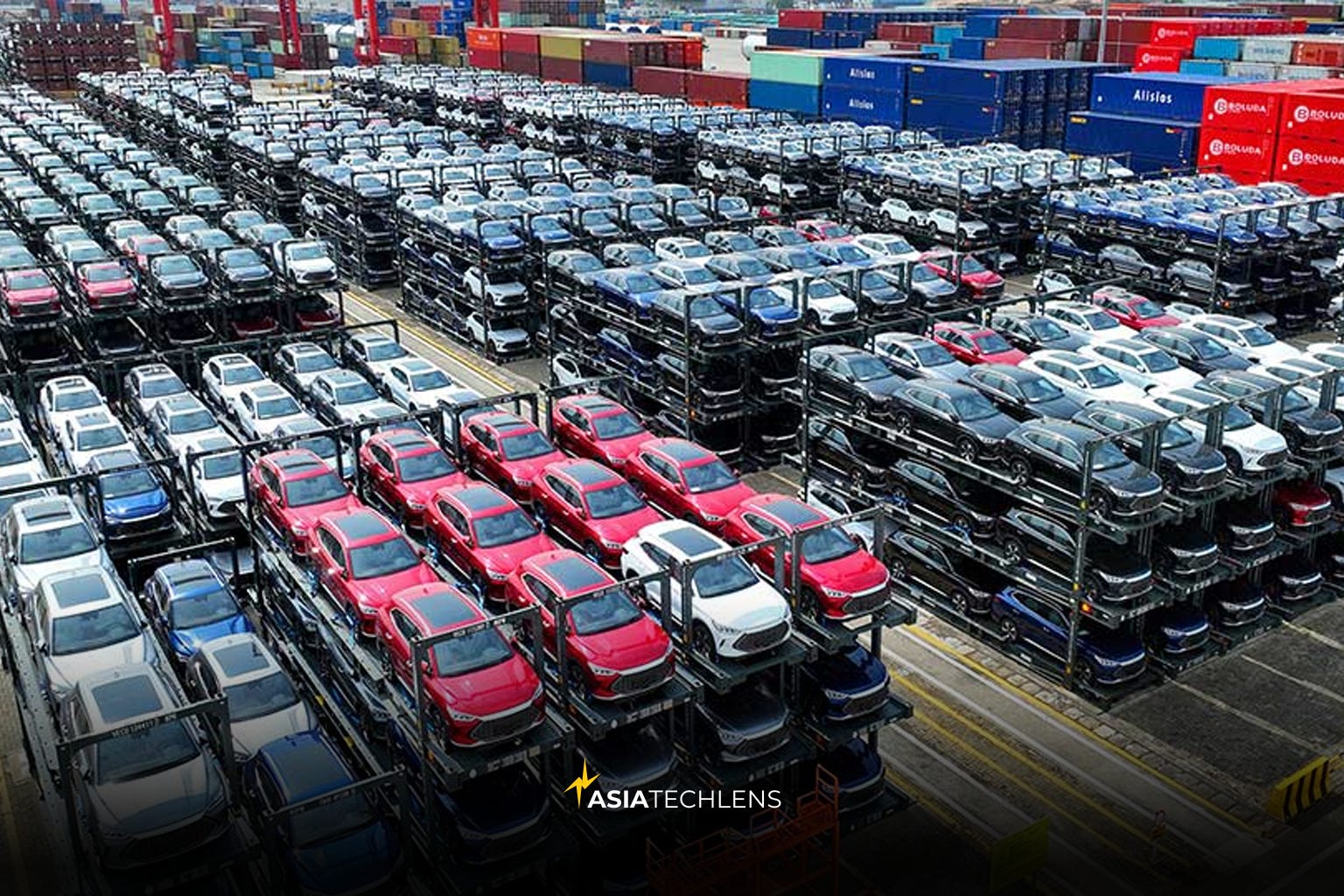

China’s EV mix is shifting: EV growth is slowing, battery prices remain higher than many expected, and hybrids are gaining market share.
At first glance, this appears to be a straightforward sales story. Within the broader EV category, the demand mix—meaning the breakdown of what consumers are choosing to buy—is tilting away from fully battery electric vehicles (BEVs) and toward hybrids, which combine a battery with a traditional combustion engine.
Hybrid models differ based on how much they rely on electricity: a HEV (Hybrid Electric Vehicle) runs mainly on gasoline and typically cannot be plugged in; a PHEV (Plug-in Hybrid Electric Vehicle) has a larger battery that can be charged from an external power source, allowing for sustained all-electric driving before the gasoline engine kicks in; an EREV (Extended-Range Electric Vehicle) operates primarily as an electric car, with a gasoline engine serving mainly as a backup generator.
Analysts estimate that BEVs could be up to 20 percent more expensive than comparable PHEVs. Lithium price pressures could add up to 3,800 yuan to the production cost of a midsize BEV, compared with roughly 2,000 yuan for a PHEV, according to recent industry research. In January this year, BEVs accounted for 58 percent of total EV sales, compared with 62 percent for 2025 as a whole. Hybrids’ market share rose accordingly.
But to focus on these sales trends is to miss the bigger picture.
For the past decade or so, China’s EV push has been built on several assumptions: battery costs would steadily fall, fully electric cars would soon cost roughly the same as gasoline vehicles, and scale would deliver sustainable profits. Companies invested billions into electric-only platforms, battery plants, and supply chains on that premise.
Now those investments are put under scrutiny. Against the backdrop of less than predictable battery prices, decision-makers are forced to rethink their capital allocation—where money has been committed, how those investments were justified, and what happens when the assumptions behind them begin to shift.
Automakers, battery manufacturers, and policymakers would, soon enough, have to grapple with the following question: if hybrids remain more popular and more economically practical than fully electric cars for the next three to five years, what part of their EV strategy should they reconsider?
Reconsider: Battery Costs and the Cost Parity Assumption
At the center of China’s EV expansion was the idea of cost parity. In simple terms, cost parity means a fully electric vehicle can be produced and sold at roughly the same cost as a comparable gasoline car, without heavy reliance on government subsidies. Once that point is reached, electric cars can compete naturally on price while preserving healthy profit margins.
The challenge is that batteries make up a large portion of an EV’s total cost. If parity slips, OEMs face a bad choice: protect margin and lose BEV share, or protect share and bleed cash through pricing. That is why hybrids matter. They are not just a consumer preference; they are a way to sell electrification with less exposure to cell cost.
Long-term procurement contracts further complicate the picture. Automakers typically sign multi-year agreements with battery suppliers to lock in volume and pricing. These contracts are meant to provide stability. But if BEV demand grows more slowly than forecast, or if battery input costs fluctuate in unexpected ways, such agreements can pressure margins instead of protecting them.
In this context, hybrids gaining share sends an important signal. Hybrids use smaller batteries and therefore rely less heavily on falling battery prices to make economic sense. If consumers—and manufacturers—find hybrids more practical in the near term, it suggests the economics of full electrification are maturing more slowly than anticipated.
Who Wins and Who’s Exposed if Hybrids Outperform BEVs
Winners:
Flexible-platform OEMs that can swing mix between BEV, PHEV, and EREV without stranding plants or tooling.
OEMs with pricing power and cash buffers that can slow BEV expansion, keep utilization healthy, and avoid margin-destructive price cuts.
Battery makers with demand diversity, meaning hybrid packs, energy storage, and export volumes that keep factories loaded even if domestic BEV growth softens.
Players with contract optionality, including volume-flex terms and indexation bands that reduce take-or-pay exposure when forecasts slip.
Exposed:
BEV-only platform bets that require sustained BEV volume to justify fixed costs and can’t easily pivot the line.
Margin-fragile OEMs that need BEV growth to cover high fixed costs and are forced into price cuts to protect share.
Cell makers concentrated on large-pack BEV demand, especially where expansion phases assume high utilization to hit unit economics.
Regions that planned infrastructure and incentives around BEV-only acceleration, where a slower BEV curve creates stranded public and private capex.
The dividing line is optionality. Flexible platforms and flexible contracts turn a mix shift into a planning problem. BEV-only capacity turns it into a balance-sheet problem.
Reconsider: Platform Strategy and Utilization Rates
The next layer of impact appears in platform strategy. A vehicle platform is the underlying structural design that determines how cars are engineered and manufactured.
Some automakers have invested in dedicated BEV platforms built exclusively for electric vehicles. These designs are optimized for large battery packs and electric drivetrains. They can be highly efficient—but only if produced at sufficient scale. They require substantial upfront capital and depend on strong, sustained demand to justify the investment.
Others rely on flexible architectures that can produce hybrids, plug-in hybrids, and fully electric vehicles on the same production line. While not as optimized for pure EV performance, these platforms offer adaptability. If demand leans toward hybrids for several years, companies with flexible systems can adjust production more easily.
This distinction matters because profits rise and fall with changes in sales volume. EV manufacturing involves high fixed costs: factories, tooling, and battery facilities. When volumes are strong, profits can increase rapidly. But when sales fall short of expectations, those same fixed costs weigh heavily on earnings.
The dynamic extends to gigafactory capacity planning. A gigafactory is a massive battery production facility designed to supply millions of EVs annually. These plants require enormous upfront investment and only generate strong returns when running close to full capacity. If hybrids require smaller batteries and BEV demand underperforms, utilization rates may decline. Lower utilization means higher costs per unit and thinner margins.
Platform choices and gigafactory buildouts are long-cycle decisions. Once capital is committed, it is difficult to reverse. When battery economics shift, these bets come under pressure.
Reconsider: Industrial Pacing
Zooming out, the issue becomes one of industrial pacing—the speed at which the entire EV ecosystem expands. This includes mining, battery production, vehicle assembly, and charging infrastructure. China accelerated this ecosystem aggressively, seeking technological leadership and scale advantages.
If BEV demand grows more slowly than expected, the question becomes one of timing. Expanding too quickly can create excess capacity and compress margins. Expanding too slowly risks ceding competitive advantage. Policymakers may need to recalibrate subsidy schedules or electrification targets to better align ambition with economic reality.
In short, hybrids gaining share is not, in itself, the central story.
The deeper story is what happens when the economic foundations of China’s EV expansion—falling battery costs, rapid cost parity, and sustained BEV scale—are tested by reality. When battery economics shift, it is not consumer sentiment alone that matters. It is capital allocation, platform design, factory utilization, and industrial pacing that determine who absorbs the shock—and who adapts.
Decision Guide Sheet
If hybrids remain more popular and more economically practical than fully electric vehicles (BEVs) for the next three to five years, what concrete decisions should automakers, battery manufacturers, and policymakers reconsider—and under what conditions?
For Automakers
If BEV sales growth underperforms expectations for 2–3 consecutive quarters: Reassess planned expansion of electric-only factories. Delay or phase gigafactory-linked capacity additions. Rebalance production targets toward hybrid or extended-range models.
If BEV factory utilization drops below ~70–75%: Shift production mix toward hybrid models where feasible. Accelerate transition to flexible platforms capable of producing multiple powertrains. Freeze new capex tied exclusively to BEV scale until demand visibility improves.
If hybrid gross margins exceed BEV margins for multiple quarters: Reevaluate product mix strategy. Prioritize profitability over pure BEV volume growth. Adjust investor guidance away from “scale at all costs” narratives.
If battery input prices remain volatile or elevated beyond forecast bands: Renegotiate long-term procurement contracts for flexibility. Reduce exposure to rigid volume commitments. Diversify battery chemistry sourcing where feasible.
For Battery Manufacturers
If BEV order growth slows while hybrid penetration rises: Reassess long-term capacity expansion timelines. Delay additional gigafactory phases not yet under construction. Increase development of smaller-pack solutions for hybrid platforms.
If utilization falls below ~80% across major plants: Consolidate production lines. Pursue export markets more aggressively. Shift production toward energy storage or non-auto segments.
If pricing pressure intensifies and margins compress: Tighten capex discipline. Prioritize higher-efficiency chemistries or cost-optimized LFP lines. Reevaluate expansion assumptions embedded in prior investment cycles.
For Policymakers
If BEV adoption plateaus while hybrids structurally gain share: Reassess electrification timelines. Consider recalibrating policy targets to reflect economic pacing. Avoid forcing demand beyond cost readiness.
If industry-wide capacity utilization weakens: Moderate further supply-side incentives. Shift policy support toward R&D and efficiency improvements rather than pure volume expansion.
If OEM margins deteriorate despite rising EV penetration: Evaluate whether subsidy withdrawal or regulatory acceleration is misaligned with industry economics. Reexamine incentive structures for hybrid vs BEV vehicles.
Related Reading On Asia Tech Lens
Not Just EVs: China Leads the World in Battery Production and Technology for all Vehicles
A battery-first look at how chemistry, materials, and scale shape cost curves, margins, and the pace of electrification.VinFast Pivots to Southeast Asia - But Can it Outrun BYD in Indonesia?
A demand-and-economics read on how Chinese incumbents pressure challengers through pricing, localization, and infrastructure constraints.Singapore’s Driverless Proving Ground: How Chinese AVs Are Turning Pilots Into Proof
A production lens on mobility deployment: regulation, operating constraints, and what it takes to move beyond pilots.The Chip War’s New Reality: A View from the Crossroads
A broader industrial framing on how China’s manufacturing scale and supply chains compound advantages across strategic sectors, including batteries and EVs.China’s Bet on Domestic Tech
A capital-allocation lens on China’s “scale-first” approach to strategic stacks (chips + compute), including the efficiency tradeoffs China is willing to accept to sustain momentum under constraints.