

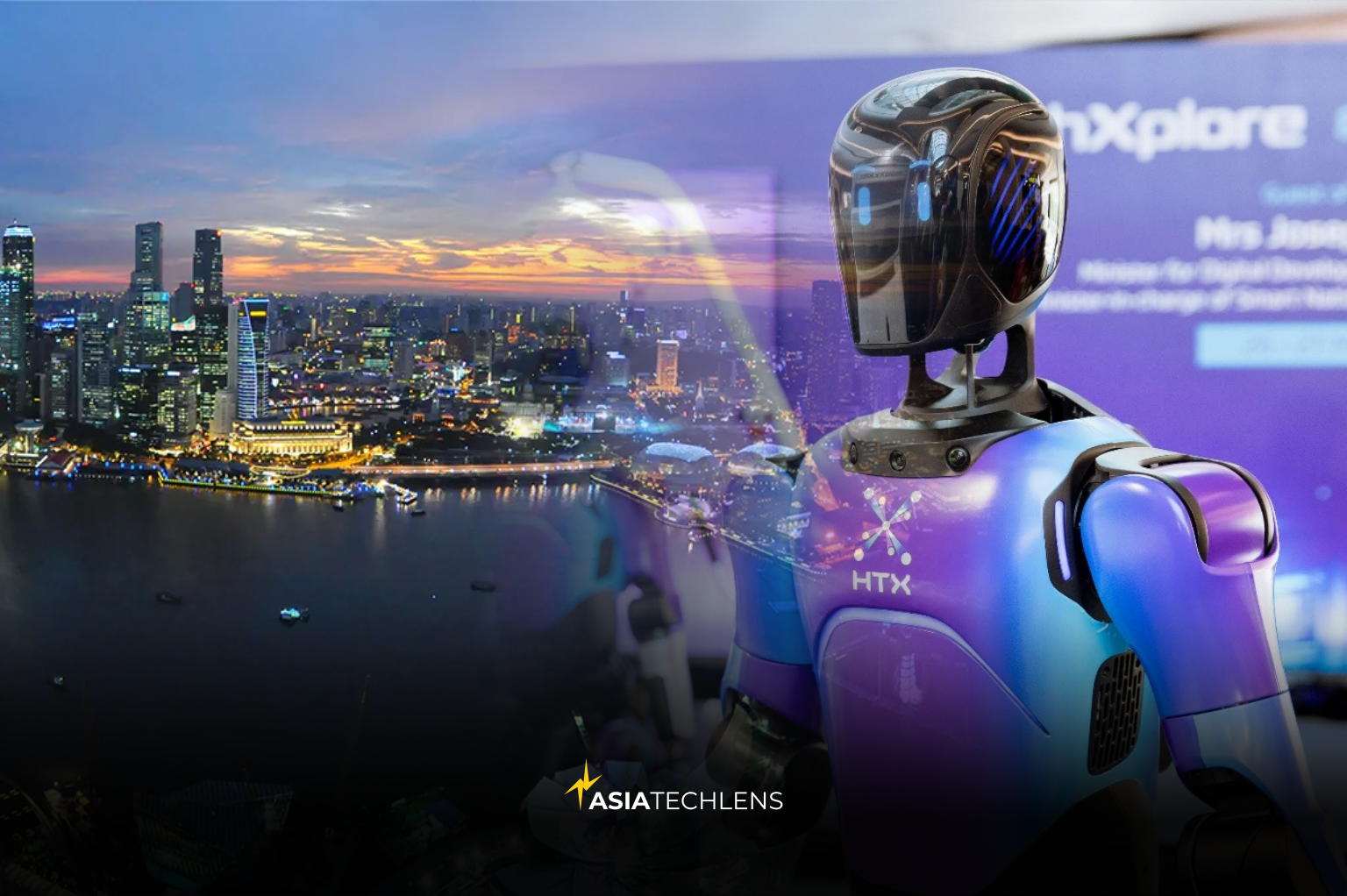
Singapore is not trying to win physical AI by building the flashiest humanoid robots or outscaling China’s manufacturing machine. Its opportunity is more specific - to become the controlled real-world testbed where AI-powered machines prove whether they can operate safely, reliably, and commercially outside polished demos.
That makes the city-state an interesting place to watch as the industry shifts toward embodied AI, also known as physical AI. Put simply, this is AI built into machines that can see, move, reason, and respond to the real world, rather than only generating text or images.
Many robots already use AI. What is changing is ambition. Instead of machines built for narrow, fixed tasks, the next wave is about systems that can read their surroundings and adjust as the conditions change. This could mean a factory system coordinating machines on the floor or a delivery robot navigating a busy building.
Several recent moves point to how Singapore wants to play this. NVIDIA plans to launch an embodied AI research hub there, giving the city-state global validation and research pull. Local startup Doozy Robotics shows the commercial ambition with plans announced in May to scale what it calls “Physical AI workforce” across the US and Asia, with a reported pipeline of more than $200 million.
Singapore-headquartered Sharpa points to another part of the story: the city-state’s emerging role in global robotics supply chains. Sharpa supplies robotic hands for a humanoid research platform involving NVIDIA and China’s Unitree.
But Punggol Digital District (PDD) is the clearest expression of Singapore’s bet. A physical AI testbed is expected later this year, giving companies and public agencies a place to find out what works, what breaks, and what is actually worth deploying.
Why It Matters Now
For the past two years, much of the AI conversation has centered on software with generative AI changing how people write and search.
With embodied AI, those capabilities are pushed into physical systems. NVIDIA’s CEO Jensen Huang has called this the “ChatGPT moment for physical AI,” when machines begin to “understand, reason, and act in the real world.”
But the shift creates a problem that software did not have. A language model can be tested at scale in a data center. A machine that needs to navigate a loading dock, avoid a forklift, and coordinate with three other robots cannot. It has to be tested in the real environment it will eventually work in.
That is what makes deployment hard. Physical AI becomes valuable only when it leaves controlled demos and enters messy, shared, human environments - factories, warehouses, public spaces, building sites. Those environments are unpredictable in ways that a lab or a staged demo is not.
Mei-Jung Chen, managing director and partner, Taipei, of BCG, argues that the excitement around physical AI comes from AI’s move into the real world, where it can change day-to-day operations and industrial processes, not just digital workflows.
This is why the opportunity could be much larger than robots. If embodied AI works, it could change how goods are moved, how facilities are managed, and how infrastructure is inspected. That raises the bar for deployment. Operators need to know whether these systems can work safely and reliably around people, equipment, and real operations.
Why Singapore Works As A Testbed
This is where Singapore’s testbed argument becomes important. Physical AI needs a place where machines can interact with people, buildings, roads, and security systems without putting public safety at risk.
Singapore has advantages here. It has dense infrastructure, advanced manufacturing, strong logistics networks, and a government that can coordinate closely with industry. It also has the kind of pressures that make automation worth testing, from high operating costs to labor constraints. These conditions can show whether an AI-powered machine is genuinely useful or only impressive in a staged setting.
Punggol Digital District (PDD) gives that experiment a physical home. As a mixed-use tech hub, it brings together business, research, education, and public spaces. That matters because physical AI will not mature in isolated labs alone.
“By leveraging the unique infrastructure of PDD, we can refine our autonomous robots in a real-world setting that mirrors the cities of the future,” said David Li, founder of Sharpa, which has partnered with JTC, Singapore’s industrial infrastructure agency, to deploy autonomous robots in the district.
The testbed could help companies find out what works in practice: whether robots can coordinate, navigate shared spaces, earn operators’ trust, and make economic sense. For Singapore, that is the bigger bet. It may not be trying to build the flashiest humanoid robot, but to become one of the places where physical AI is stress-tested before it scales.
Why Operators Need To Care
For industrial operators, physical AI could change the economics of automation. Traditional automation often relies on machines built for specific tasks, from robotic arms on production lines to warehouse systems on fixed routes. Physical AI promises more flexibility. It creates machines that can be retrained for new products, workflows, or operating conditions without replacing the whole setup.
BCG’s Mei-Jung Chen believes that this flexibility matters as companies rethink supply chains, bring some production closer to home, and struggle to find enough workers for repetitive or difficult jobs. In that context, physical AI becomes less of a tech experiment and more of an operational question.
For operators, physical AI has to earn its place in the workflow and fit into existing systems without creating new risks. Industrial enterprises should treat these systems as a long-term operational bet. “Don’t look at AI as an expense or a cost. It’s an investment for the future,” said Chen.
The competition is also moving quickly. In China, embodied AI is already being framed around industrial production, public services, and special operations, with state media saying the country’s embodied intelligence industry is growing at more than 50% a year. That figure shows the scale of China’s push. China’s advantage is industrial mobilization, manufacturing depth, and the ability to move quickly across production networks.
For Singapore, the challenge is turning dense infrastructure and high-profile partnerships into a practical advantage.
Singapore’s edge is different. It lies in trust, infrastructure density, regulatory coordination, and enterprise validation. In physical AI, those are not secondary advantages. They are what determine whether machines move from demo videos into daily operations. Whether Singapore can turn those advantages into a durable role in physical AI remains an open question. But it is one of the few places seriously trying to answer it in the real world.
More From Asia Tech Lens
Singapore's Robots Don't Go Viral — They Go Global
How Singapore's robotics startups are building for export, with orchestration software and no-code platforms emerging as the real competitive edge.
Beijing's five-year plan bundles proven factory automation and speculative humanoid robots under the same policy umbrella and why that gap is the first thing operators in manufacturing need to close.
China's Robot Spectacle Is an Industrial Strategy
Why the Spring Festival Gala's humanoid showcase was less a technology demonstration and more a deliberate signal of China's push to move robots from controlled environments into the real world.
Inside China's Bold Push to Build Humanoid Robots: Here Are 5 Companies Leading the Charge
A close look at the Chinese companies turning humanoid robots from research-stage prototypes into industrial deployments.
The Man Behind Unitree: Insights on AI, Adoption, and Growth
Unitree's founder on the real bottlenecks holding back humanoid robots, why the industry's ChatGPT moment is still years away, and what foundations need to be built first.