

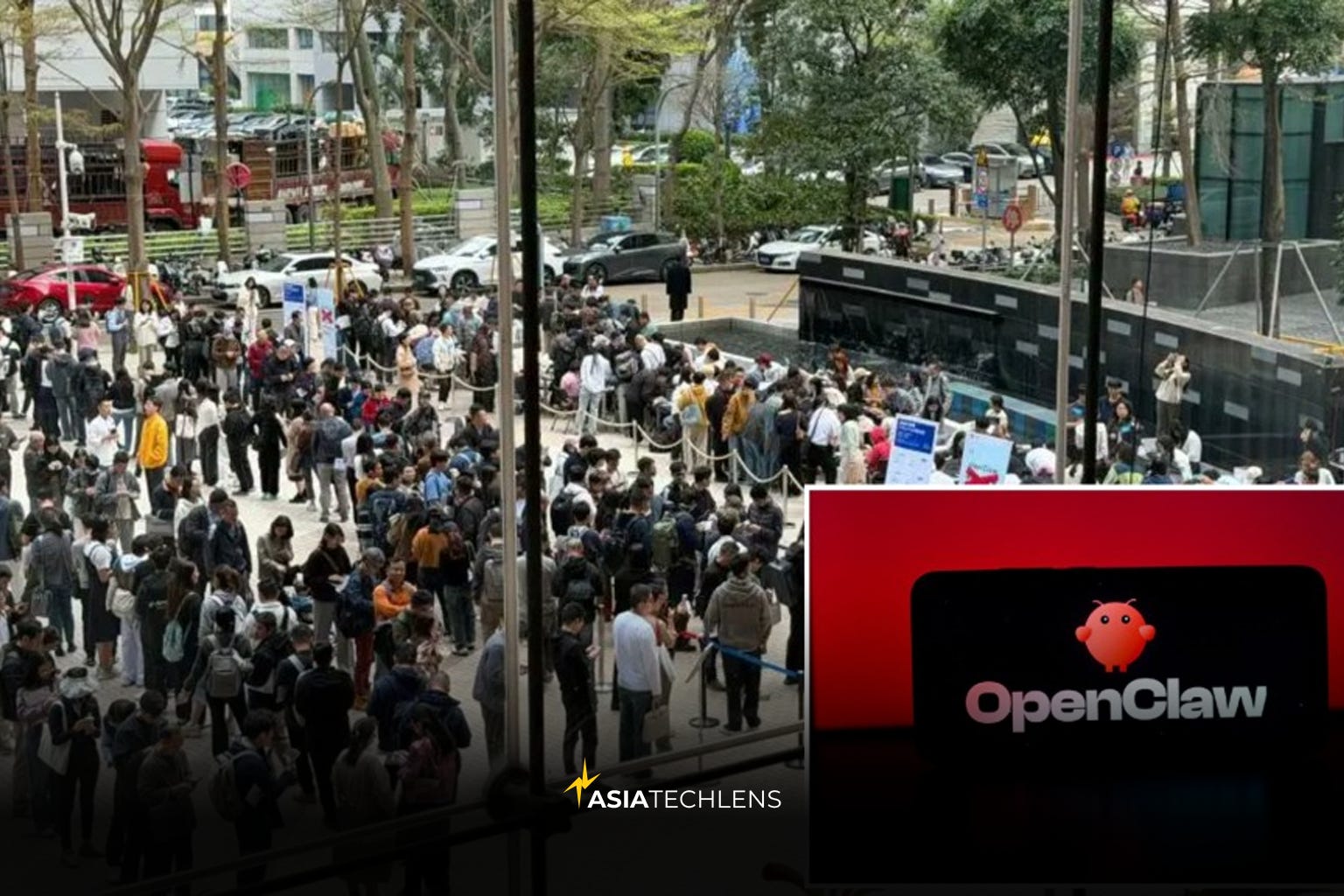
On the morning of March 6, Tencent’s cloud engineers set up free installation booths outside their Shenzhen headquarters for OpenClaw, an open-source AI agent that can autonomously run tasks on a computer. Students stood alongside retired engineers. Someone had flown in from Hangzhou. Meanwhile, across the city, Taobao sellers were charging up to 500 yuan per remote install, with the busiest stores logging over a thousand orders. ByteDance, Alibaba, and other major cloud providers had already launched their own one-click deployment services. China’s own cybersecurity regulator had issued a formal warning about the same software just weeks before.
What OpenClaw Actually Does
OpenClaw started as a hobbyist GitHub project in November 2025 and within weeks had become one of the fastest-growing AI agent projects in the world. It links a large language model to tools such as messaging, browser control, file systems, scheduling, and command execution. In practice, that means it can handle tasks like filing reports, managing files, running shell commands, booking calendar slots, and writing code with limited human intervention.
What makes it notable is not that it replaces APIs altogether, but that in some workflows it can operate through the interface layer rather than relying on clean, purpose-built integrations. That matters in legacy-heavy environments, where AI projects often stall because every new deployment requires API work, permission redesign, vendor coordination, and system-by-system integration. OpenClaw changes that conversation by offering a way to work across messy stacks without waiting for all of that to be rebuilt first.
In China, that integration problem is especially acute because many large enterprises still run on fragmented IT estates built up over years of legacy systems, custom fixes, and weak documentation. Traditional agent deployment requires remapping those systems from the ground up. OpenClaw bypasses that but it is considerably slower. Each step takes 15 to 30 seconds compared to 1 to 3 seconds for a properly integrated agent. For enterprises blocked by integration costs, however, that is a price worth paying.
Reading the Subsidies Correctly
The frenzy did not go unnoticed by local governments. Shenzhen’s Longgang district, home to China’s first AI and robotics bureau, released a draft policy on March 7 proposing financial support of up to 2 million yuan (USD 276,000) for approved OpenClaw application projects, with larger commitments of up to 10 million yuan (USD 1.4 million) for more substantial ones, alongside free compute credits and discounted office space. Wuxi’s high-tech district followed two days later, offering between 1 and 5 million yuan (USD 138,000 to USD 690,000) for industrial applications including quality inspection and equipment maintenance.
In the same news cycle, China’s Ministry of Industry and Information Technology issued a formal warning that default or poorly configured OpenClaw deployments create serious exposure risks, and that public access and permissions must be tightly controlled. The Chinese state was simultaneously encouraging and cautioning against the same technology. That is not a contradiction to explain away. It is the most honest signal available about where OpenClaw actually sits: useful enough to promote, risky enough to warn against, and not yet resolved into either. Everything else in this piece follows from that.
These are district-level draft proposals, not central government policy. Longgang’s measures are still open for public comment until April 6. The goal is to attract developers and startups into a nascent ecosystem, not to signal that operators have tested and validated the technology. No one has signed off on a return on investment yet.
The cloud vendors are making a similar calculation. Alibaba Cloud, Baidu Intelligent Cloud, ByteDance’s Volcano Engine, JD Cloud, and Tencent Cloud all launched one-click OpenClaw deployment within weeks of the project going viral. Installation is free, but cloud compute, bandwidth, and API calls are chargeable, meaning every task OpenClaw runs on a cloud server generates a bill.
On March 9, several China cloud and software-linked stocks jumped around 20% amid policy support and OpenClaw enthusiasm. That looked more like a bet on infrastructure demand than on proven enterprise deployment revenue.
The Constraint Map for Regulated Industries
Access and Audit Gaps
OpenClaw includes some security controls and tool restrictions, but it does not natively provide the kind of enterprise-grade RBAC, centralized policy enforcement, and regulator-friendly audit architecture that banks, hospitals, and critical-infrastructure operators typically require. For firms in regulated industries, such as a bank that must demonstrate data access controls to its regulator, a hospital managing patient records, or an energy company operating under national security protocols…who accessed what data and when is a compliance requirement. And these are not gaps that better configuration will fix - they are baked into how the tool is built.
Security is Already a Flagged Problem
SecurityScorecard identified over 135,000 OpenClaw instances exposed to the public internet as of February 2026. A separate independent study found that 42,665 of those exhibited authentication bypass conditions, meaning they could be accessed without any credentials at all. Three critical security vulnerabilities have been formally catalogued in the software, each with publicly available attack code, meaning the tools to exploit them are already in circulation. One of them, even when OpenClaw is configured to run only on a local machine rather than over the internet, allows an attacker to remotely execute their own commands on that machine and intercept the access credentials the agent holds. A further six vulnerabilities cover issues including missing authentication and unauthorized file access. More than 800 confirmed malicious add-ons have been found within OpenClaw’s own plugin registry.
China’s Ministry of Industry and Information Technology had already moved. In February, it issued a formal warning that default or poorly configured deployments create serious exposure risks and that public access and permissions must be tightly controlled. The advisory was not issued in isolation. It landed in the same week as the district subsidy announcements.
The Continuity Risk
In February, OpenClaw’s founder announced he was joining OpenAI and that the project would move to an independent open-source foundation, with OpenAI committed to supporting it. There are no reports of a foundation being formally established. OpenAI has publicly backed the arrangement, but the company has its own complicated history with open source commitments, and is currently facing litigation over its transition from a nonprofit to a for-profit entity.
For operators considering dependency on this tool, that context matters. The governance structure that will oversee security patches, licensing terms, and the development roadmap does not yet exist in a defined form. Until it does, there is no clear entity to hold accountable if something changes.
The Data Exposure Problem
Data volume is a further concern. Each task OpenClaw completes generates a trail of processed text, measured in units called tokens. A single active session can exceed 200,000 tokens. A power user can consume up to 50 million in a day. That data moves through the underlying model, through the messaging platform OpenClaw connects to, and in many configurations through a third-party cloud server. For firms handling sensitive information, the exposure surface widens with every task the agent runs, with no guaranteed boundary around what leaves the organization.
The Rest of Asia Has a Different Calculation
For operators in regulated Asian markets outside China, the calculation is different. The subsidy schemes are district-level Chinese policy, not a regional endorsement. The one-click deployment push is also running through Chinese cloud providers, which means the speed, cost, and convenience of adoption are being shaped by a domestic ecosystem rather than by a model that travels easily across borders.
Part of what has made OpenClaw compelling in China is the cost structure around it. OpenRouter data in late February showed Chinese-developed models accounting for 61% of token consumption among the platform’s top ten models, pointing to a pricing and usage dynamic built on Chinese infrastructure, intense domestic competition, and Chinese regulatory conditions. Those economics are part of the story, not a backdrop to it.
None of that carries cleanly into Singapore, Jakarta, Manila, or Mumbai. Operators in those markets would be adopting the same architecture without the subsidy window that lowers early risk, without the cloud ecosystem that makes deployment friction lighter, and without the cost structure that has helped make the trade-off look attractive in China. They would still be taking on the same security, governance, and continuity risks, but with fewer of the offsetting advantages.
The frenzy is therefore substantially a China-domestic story. Treating China’s current adoption wave as a universal signal is where operators outside mainland China are most likely to make a premature and expensive commitment.
What to Do With This, Right Now
The architecture underneath OpenClaw is real and the direction of travel is not in doubt. But the signals surrounding the current frenzy are a different matter. Stock moves indicate compute demand, not deployment proof. Subsidies signal ecosystem building, not validated operator returns. Cloud vendor moves signal infrastructure opportunity, not technological readiness for regulated environments.
First, understand the architecture properly before the next board conversation arrives.
OpenClaw’s screen-level approach to legacy integration is a genuinely new capability, and knowing what it can and cannot do is table stakes for any technology leader in Asia over the next 12 months.
Second, identify one contained pilot candidate: a workflow that sits behind a legacy interface, involves no sensitive data, and has a clear enough output to measure whether the agent actually performed. Run it. Learn from it. Do not scale it.
Third, watch the governance transition closely. The establishment of the OpenClaw foundation and the terms under which OpenAI supports it will signal whether this project is heading toward enterprise readiness or toward becoming an OpenAI product feature. Those are very different outcomes for an operator evaluating dependency.
Fourth, do not let the China frenzy set the timeline. The subsidy window is short and the obsolescence risk is real. The vendors currently subsidizing adoption are building toward native agent layers that may make OpenClaw’s middleware position redundant. The evaluation window exists independently of their promotional cycle.
The operators who come out ahead will be the ones who use this window to build understanding rather than dependency. The current moment rewards speed in headlines and punishes it in production.
Related Reading On Asia Tech Lens
At WAIC Hong Kong, the AI Conversation Has Moved Past the Model Race The two-stack decision frame for operators in third market.
China's Robot Spectacle Is an Industrial Strategy
China's deployment playbook and subsidy cycle logic.
The Chinese New Year AI Gateway War
Cloud vendor pile-on and what happens when incentives end.
What Tencent’s Yuanbao PAI Reveals About Its AI Strategy
A read on how Tencent uses mass adoption moments to force trial and legitimize new technology behaviors at scale.
India's AI Push Is Real. Production Access Is the Constraint
Why India's AI ambitions are running ahead of its deployment infrastructure, and what that means for operators building now.