


When enterprises across Asia start a quantum pilot, they often begin by asking what the technology can do for them. The entry point can produce interesting pilots but they will likely go nowhere—no procurement decision, no budget owner, no path to deployment, no business impact.
Alexandra Beckstein, CEO of QAI Ventures, has spent enough time inside these programs to know exactly where that happens. “Teams ask where they can use quantum, rather than asking which decision is costly, complex, and worth improving. That usually leads to a pilot that sounds exciting but is too vague to succeed,” she says.
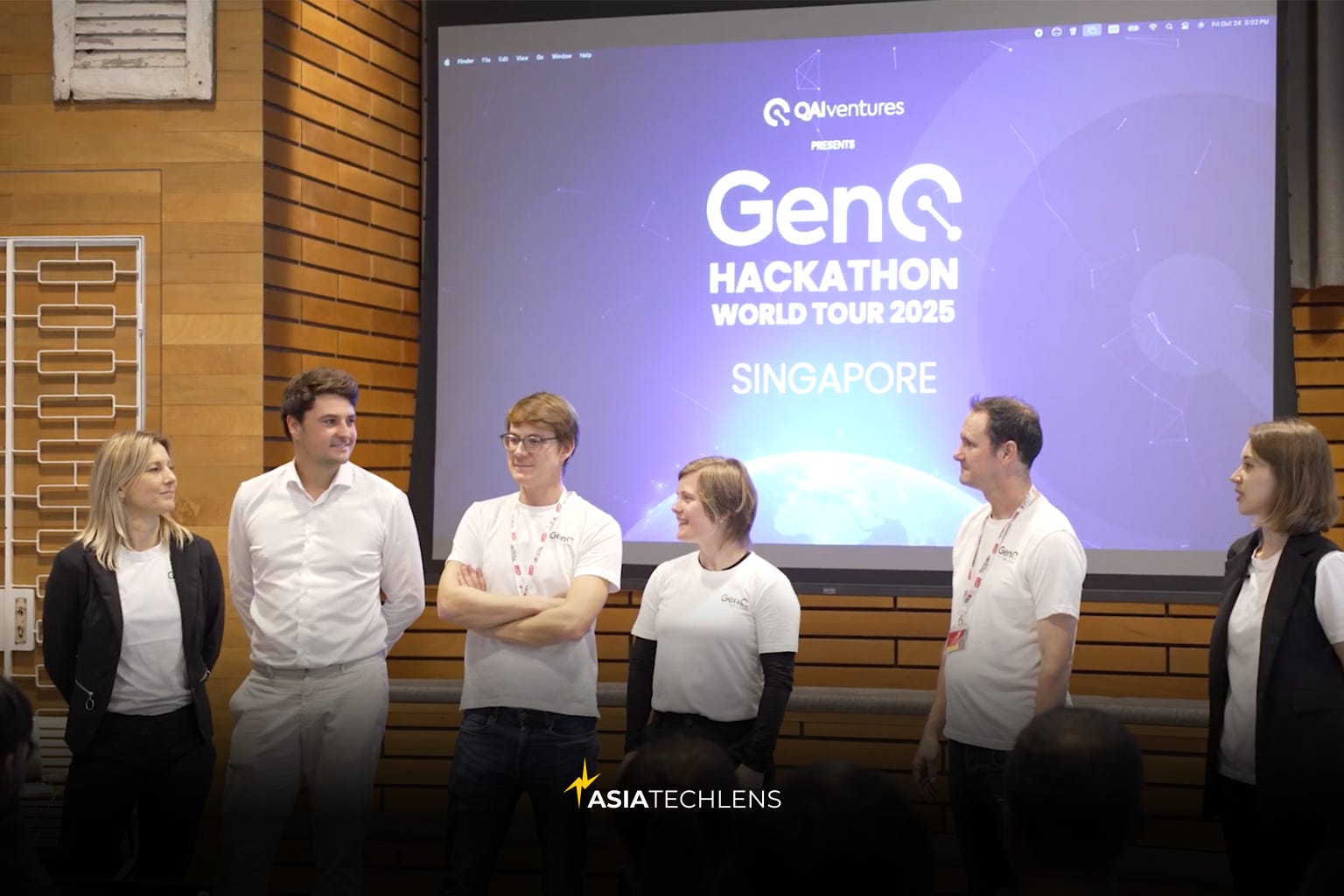
Beckstein runs QAI Ventures, a Switzerland-founded firm with its Asia-Pacific headquarters in Singapore. In February, the firm announced an industry cluster program backed by SoftBank Corp. and HorizonX. Beckstein has built quantum startup ecosystems across Europe, North America, and Asia Pacific. She has seen where the pipeline breaks for many enterprise quantum programs. She shares her insights in a written interview with Asia Tech Lens.
The Wrong Question Is Being Asked First
What she keeps finding is that the decision that determines a pilot’s fate is made at the very beginning. Teams enter quantum programs by asking where the technology can be applied rather than which specific, costly business decision needs to be improved. That produces pilots that are technically interesting but commercially vague.
The most reliable early signal that a pilot is incorrectly structured is the absence of a P&L owner. “A pilot needs a defined P&L owner who is accountable for outcomes,” Beckstein says, “not just an innovation or IT team exploring new tools.” If the initiative lives inside an innovation function without a business unit accountable for the result, it is not a business pilot. It is an experiment with a business-shaped label. In regulated industries—banking, insurance, or telecommunications—a pilot without a business owner rarely makes it past procurement, regardless of how technically promising the results are.
The failure pattern has a structural cause. On the supply side, researchers with strong IP often lack business scaffolding. They don’t have the capacity to translate technical capability into a deployable system. On the demand side, enterprises are aware of quantum as a category but have no capacity to structure a pilot that produces evidence procurement can act on. QAI Ventures is positioned around both sides of that gap. Most of what is deployable today is quantum-inspired or hybrid, not full quantum computing, which remains dependent on hardware breakthroughs that have not yet arrived. While quantum research is maturing, enterprise deployability is a separate endeavor.
Beckstein recalls a case where a company attempted to tackle a very large planning problem too early: the data was inconsistent, the business team had not agreed on a success metric, and the project became too broad to produce a clean result. “The lesson was simple,” she says. “Start with a smaller problem, cleaner data, and a tighter commercial goal.”
What A Correctly Framed Pilot Looks Like
Three cases Beckstein points to illustrate what problem-first framing produces in practice; the figures that follow are drawn from her account. The following cases are not arguments for quantum broadly. They are examples of when a specific problem is matched to the right method.
Multiverse Computing applied its Singularity framework to compress AI models for a customer service network. The outcome was an 80% reduction in model size and up to 75% lower energy consumption, with no degradation in response quality. The business case—cost reduction and sustainability—was defined before the quantum-inspired approach was selected, not after.
Fujitsu’s Digital Annealer, deployed at the Port of Hamburg, optimized vehicle traffic flows and increased average travel speed by 20% while cutting CO₂ emissions by 10%. More operationally significant: a calculation that previously took days now runs in seconds. The framing was a logistics bottleneck the port already owned. The quantum-inspired approach was chosen because classical methods had hit a scaling ceiling.
QTFT, a quantum software startup founded in Thailand, built a routing solution for supermarket goods deliveries that generates several strong, viable alternatives rather than a single theoretically optimal route. For a logistics operator, that distinction matters at the moment a route fails and a decision needs to be made in minutes, not hours.
As Beckstein puts it, these cases share something fundamental: “A focus on solving genuine operational constraints and producing results that procurement and operations leaders can directly compare against their existing benchmarks. That is ultimately what separates promising pilots from deployments that stick.”
Her point is that success criteria need to be quantified before a pilot begins. For example, a 3% or greater improvement over a well-understood classical baseline. Without that number agreed in advance, the pilot has no natural endpoint, and no moment at which anyone is obligated to act on the result.
How To Run It, And When To Stop
The second failure mode Beckstein flags is less about framing and more about discipline. Pilots run too long because nobody agreed on exit criteria before they started. By the time results are inconclusive, the budget has been spent and the business owner has moved on.
Her stop rules are unambiguous: “A pilot should stop if the data is not good enough, if the business owner is not engaged, or if the result is not clearly better than the current approach. It should also stop if costs keep rising without stronger evidence.”
In regulated industries, the governance layer deserves particular attention—it is a condition of deployment. In banks, insurers, telcos, and critical infrastructure, the demo is not the hard part. Auditability, reproducibility, vendor risk, security, compliance, and long-term support are what procurement will flag. Pilot teams that do not document these early should not be surprised when a technically promising project stalls at the procurement stage.
Not every category is ready for enterprise piloting. The categories Beckstein sees as decision-relevant in the next 12 to 24 months are specific: quantum-safe security planning in regulated sectors, financial services workflows including pricing, risk, and fraud detection, and operational planning in logistics, energy, and supply chains. What she is explicitly not backing are categories that still depend on hardware breakthroughs before they can deliver enterprise value. For operators choosing between vendors, that boundary is a useful screen: if a vendor’s pitch depends on technology that does not yet work at enterprise scale, no amount of careful pilot design will produce a deployable result.
To move from exploration to a budget line-item, Beckstein is clear about what needs to be in place: “A clear owner, clear business value, usable data, and a realistic path to implementation.” If any of those four are absent, the pilot is not ready.
Before funding a quantum pilot, operators should be able to answer the following: which expensive decision is worth improving, why current methods are no longer sufficient, and whether a quantum-inspired or hybrid approach can beat a defined baseline under real conditions. If that cannot be answered upfront, the pilot should wait.
More From Asia Tech Lens
Can India Build Quantum Computers That Matter Globally?
India’s quantum push shows why national ambition is only the first step; the harder test is turning research capacity into commercially relevant systems.Why Japan’s Quantum Strategy Starts With Algorithms, Not Qubits
Japan’s approach underlines the same near-term lesson: quantum value may arrive first through applied software and workflow improvements, not hardware breakthroughs.Singapore’s Quantum Bet: Where AI Meets the Next Compute Revolution
Singapore’s quantum ecosystem helps explain why the region is trying to close the gap between research investment and enterprise deployment.Agentic AI Can Act. Singapore’s New Rulebook Says: Prove You Can Stop It.
Like quantum pilots, agentic AI deployments show that advanced technology only earns enterprise trust when governance, control, and accountability are built in early.India’s AI Push Is Real. Production Access Is the Constraint
This piece echoes the same deployment problem: emerging technology only matters when it can move from promise to production infrastructure.