

A physical AI pilot can turn workers, processes and failures into training material for a model your company does not control.
For a COO, CIO or an automation leader, that raises a question conventional equipment contracts may not clearly be able to answer: what can the robot learn from your factory, where will that learning go and what are your rights after the pilot ends?
The issue does not apply to fixed, pre-programmed robots that learn nothing from customer-site data. It only arises with learning-enabled systems that use demonstrations, feedback and failure cases to improve their own policies or a supplier’s broader model.
That learning may be essential. Worker demonstrations and recovery procedures are often what make robots useful outside a laboratory. But before deployment, manufacturers must decide what can improve a shared model, what must remain site-specific and what capability they retain when the relationship ends.
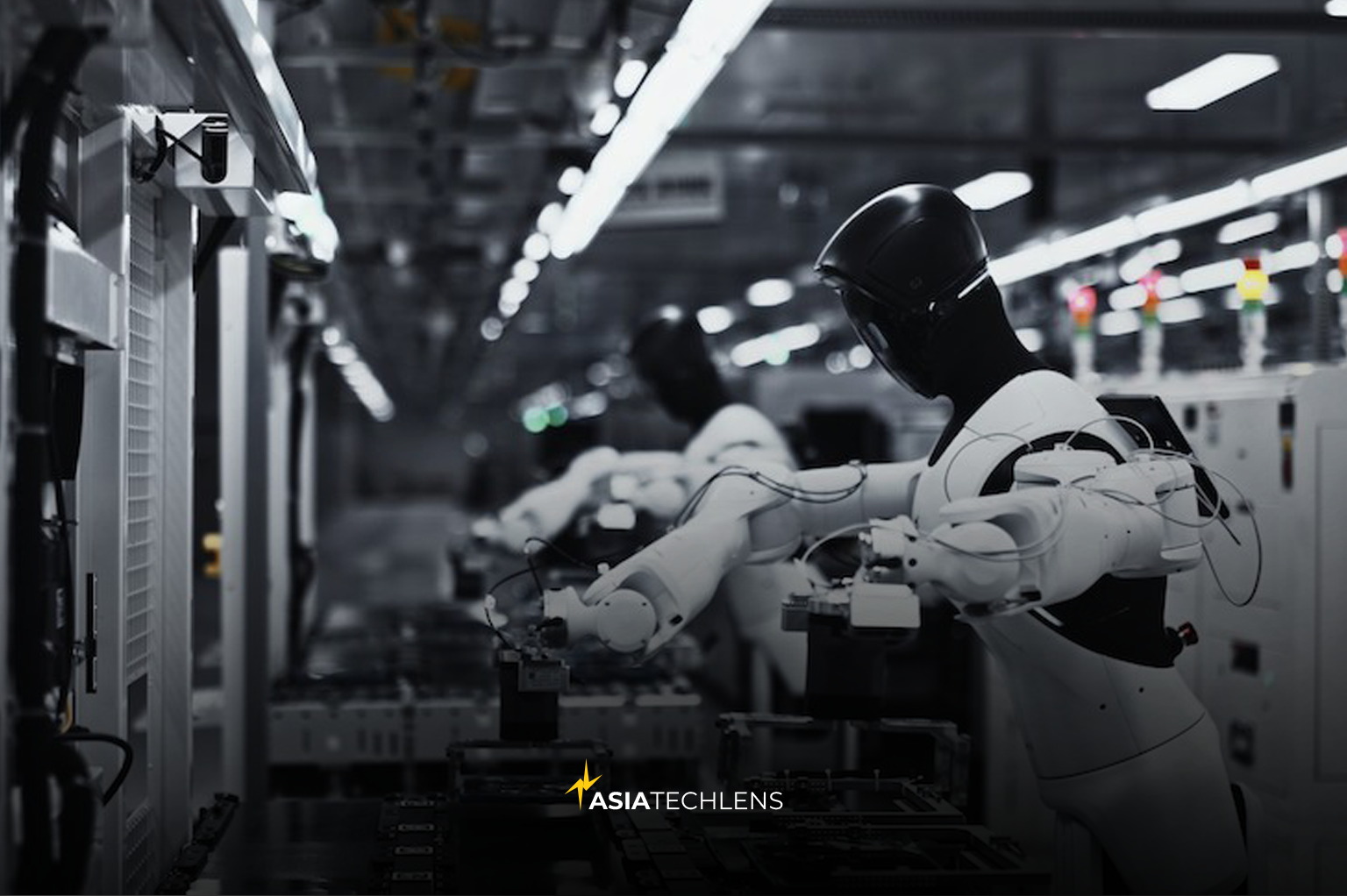
At the recently concluded World Artificial Intelligence Conference in Shanghai, TARS reportedly recreated an automotive wiring-harness production line in which multiple robots grasped, routed and assembled flexible components. The demonstration showed embodied AI moving toward complex industrial work. The less visible question is who controls what the system learns once it enters a customer’s factory.
The Factory Becomes the Training System
Digital AI can learn from online material. Robots need physical data: how objects bend or slip, how workers respond to abnormalities, and how production continues when formal processes fail. That data is difficult to generate and increasingly valuable.
At AgiBot’s Shanghai data-collection site, about 100 robots are operated by roughly 200 people for up to 17 hours a day. Robot learning is also entering operating factories. TARS plans to deploy 100 robots at an Aptiv plant in 2026 and use production-line data to train its general embodied AI model. Spirit AI has said it will collect data and train models in Bosch China factories and logistics centers.
These examples do not demonstrate widespread misuse. They show manufacturers becoming contributors to model development before the value and rights attached to that contribution are clearly defined.
That is enough to create a procurement risk. Treat every learning-enabled robotics deployment as both an automation contract and a model-training agreement.
The Value Exchange Can Become a Switching Problem
A factory supplies the environment that makes the system useful: workers demonstrate tasks, engineers correct trajectories and failures expose edge cases. The robot then becomes embedded in equipment, workflows and supplier support while its performance improves through continued exposure to the site.
If the vendor later raises fees, cuts support, discontinues the product, or becomes hard to work with because of financial, regulatory or geopolitical disruption, the manufacturer can buy another robot but cannot move the capability it has built. The governance failure begins when the factory contributes learning without defining what it will receive or retain in return.
Portability must be treated realistically. A policy trained for one robot may not run on another because machines use different sensors, controls, action spaces, kinematics and physical configurations. Cross-embodiment transfer remains an active research challenge, so an export right does not guarantee plug-and-play interoperability.
An exit agreement should instead preserve what is needed to understand and reconstruct the deployment: demonstrations and annotations, task specifications, site maps, configurations, interface documentation, performance histories and failure-recovery records. Where available, manufacturers could also seek customer-specific task configurations, policies or other deployment artifacts. Contracts should specify the format, documentation and transition support accompanying them.
The goal is not to fit one robot’s brain into another body. It is to avoid rebuilding the deployment from memory.
Your Objective Is Control, Not Necessarily Ownership
Manufacturers don't need to own the supplier's model or every improvement from deployment. Once a supplier blends your data with other customers' and its own, ownership gets impractical, and sharing it tends to complicate maintenance, liability and decision-making.
What matters is a defined set of rights: what the system may collect, which models the information may improve, how the resulting capability may be reused, what value the manufacturer receives and what access continues during and after the contract. Agreements may include limits on reuse in directly competing applications and should specify which customer-specific outputs, configurations or services remain available at termination.
Joint ownership may suit strategically important deployments. But the central question is who may use the improvement, for what purpose, under which restrictions and for how long.
Divide Factory Learning Into Three Categories
Classify learning during procurement, while the manufacturer can still decide what can enter a shared model and what must remain protected.
Pool commodity motion
Basic navigation, routine material movement, standard grasping and common safety responses can usually contribute to a shared model. They reveal little competitive knowledge, and pooling them may reduce costs and prevent robots from relearning standard tasks at every facility.
Negotiate site-specific learning
Plant layouts, equipment placement, production rhythms, worker interactions and local failure patterns need stronger controls. They may not reveal a proprietary technique, but they can expose operational weaknesses or deepen dependence on the supplier. Contracts should define how this information is aggregated, anonymized, retained and reused, including whether improvements can be deployed across the manufacturer’s own sites.
Protect proprietary method
Product-specific assembly, specialized tooling, defect analysis, quality judgements and recovery procedures may encode tacit intellectual property accumulated through years of production experience. They should not automatically improve a supplier’s general model.
Protection may include keeping specified material outside pooled training, using it only to fine-tune a separately maintained customer-specific model or policy where the architecture permits, or imposing purpose-based limits on external reuse.
The operating rule is simple: share commodity motion; protect proprietary method. The boundary will not always be clean, so the categories are a procurement framework rather than a claim that every update can be perfectly separated after training.
Data Localization Does Not Guarantee Learning Localization
Many Asian manufacturers already run data-compliance controls that make a robotics deployment look handled.
In China, the Personal Information Protection Law channels overseas transfers of personal information through mechanisms such as a security assessment, certification or standard contract. It also requires critical information infrastructure operators and processors handling personal information above prescribed thresholds to store that data domestically.
Vietnam’s Decree 53 applies domestic-storage requirements to specified categories of user data. These include personal information, account and service-use data, and information about users’ relationships. Covered foreign digital-service providers can also be required to store that data locally and establish a local presence following a formal government request under specified conditions.
Indonesia’s Personal Data Protection Law uses a transfer hierarchy: the receiving country should provide equivalent or stronger protection; failing that, the controller must ensure adequate and binding safeguards; if neither condition can be met, it must obtain the data subject’s consent.
Malaysia permits overseas transfers where the destination has substantially similar law or an adequate level of protection, while also recognizing grounds such as consent, contractual necessity and due diligence by the controller. Its cross-border transfer guidelines emphasize notices, assessments, and records supporting the chosen transfer basis.
Compliance with these regimes does not by itself establish who may use a model update, task policy or distilled capability derived from factory activity. Nor does it necessarily protect non-personal process knowledge such as tooling methods, quality judgements and recovery procedures.
Compliance teams therefore need to make an additional deployment decision: where training occurs, whether updates or distilled capabilities leave the facility, whether customer-specific models are merged into shared systems, what remote access the supplier retains, and which non-personal learning requires contractual protection.
Apply a Robotics Learning-Rights Test
Before approving a pilot, answer four questions.
1. What can the system collect?
Map every input available to the robot and supplier, including sensor feeds, demonstrations, execution logs, production metrics, workspace maps, corrections, failures and human interventions. Limit collection to the agreed task, including indirect information revealed through worker corrections and recovery actions.
2. Which models can it improve?
Assign each category of information to a permitted destination: a shared model, a customer-specific model or policy, or no training use. The contract should govern not only raw data, but also whether updates, embeddings or distilled capabilities may leave the facility or enter a broader system.
3. What does the manufacturer receive?
If the supplier receives reusable learning, negotiate identifiable value in return. That may include lower fees, performance commitments, rights to use customer-specific outputs across the manufacturer’s facilities, restrictions on external reuse or task-specific intellectual property. Tie that value to agreed data, deployment periods, use rights or measurable milestones rather than exact attribution.
4. What survives termination?
Specify which customer-specific materials, outputs, access rights and transition support remain available after the relationship ends. Define delivery formats and documentation before the pilot begins.
The Procurement No-Go Rule
Learning-enabled robots can deliver more adaptable automation, but manufacturers should not contribute worker expertise, production variation, and proprietary recovery methods under an agreement written only for hardware maintenance and data storage.
Do not approve a learning-enabled robotics pilot unless the contract specifies what may be collected, which models it may improve, what the manufacturer receives in return, and what capability, access and transition support survive termination.
Go Deeper on Asia Tech Lens
Two Robots, One Plan
China’s robotics strategy separates proven industrial automation from humanoid ambition and shows operators where deployment is ready now.Singapore Wants to Be the Testbed for Physical AI
Singapore is positioning itself as a real-world proving ground for robots, giving operators a framework for testing reliability before scaling.China’s Robot Spectacle Is an Industrial Strategy
China is using state-backed demonstrations and early deployments to generate the operational data humanoid robots need, showing operators how spectacle can become an industrial learning system.
The Man Behind Unitree: Insights on AI, Adoption, and Growth
Unitree founder Wang Xingxing explains why limited real-world data and immature AI models—not robot hardware alone—remain the biggest barriers to useful, general-purpose robots.
Inside China’s Bold Push to Build Humanoid Robots
A company-level guide to five Chinese humanoid robotics firms, showing how supply-chain depth, in-house manufacturing and factory trials are accelerating the move from prototypes toward industrial deployment.