

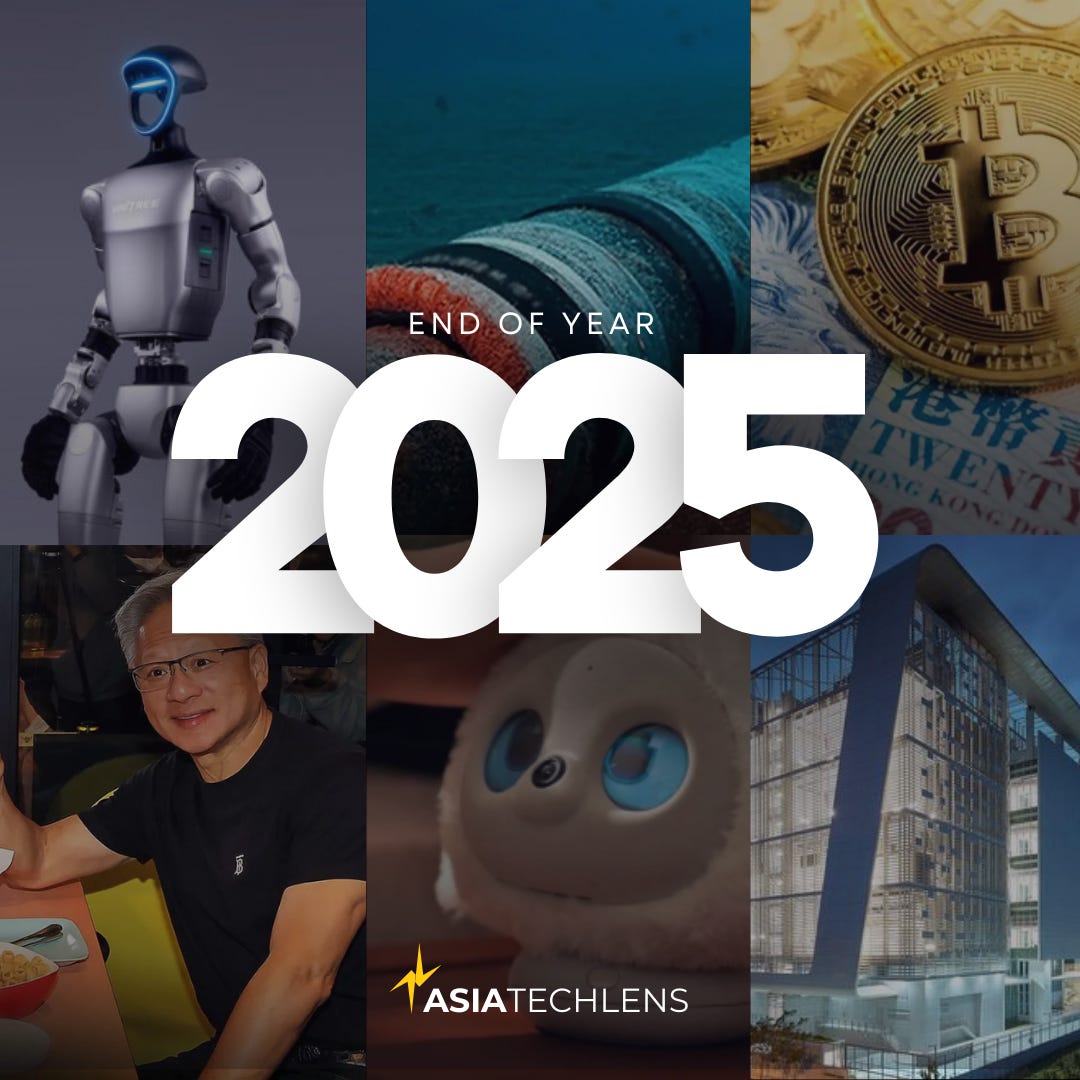
Editor’s Note: If 2025 had a single headline, it would not be “AI Goes Mainstream” or “Asia Leads Innovation.” It would be: “Ambition Collided with Constraint.” And constraint shaped the outcomes far more than the hype cycle was willing to admit.
We launched Asia Tech Lens in April this year, and we saw that collision up close. Chinese AI firms put American giants on the backfoot by changing the economics, not by out-spending them. DeepSeek’s low-cost training claim captured the shift: efficiency became the advantage. Chinese models climbed global leaderboards, and Nvidia’s Jensen Huang publicly praised China’s “world-class” AI innovators.
This was also the year when subsea cables, cooling systems, and the power draw of data centers moved from footnotes to gating factors, because they now decide what can scale, and where.
Eight months in, three things stood out. Capability rose, but permission tightened, with governance, security, and policy boundaries shaping product decisions. The physical layer became strategy, not operations. And Asia stopped copying playbooks and started building for its own constraints, from local languages to fragmented markets.
Asia Tech Lens is still early. In 2026, our promise is not just volume. It is deeper, more patient reporting that prioritizes durable levers over viral moments, and treats readers as collaborators in building a sharper point of view on where Asia’s tech power is actually accumulating.
What We Published in 2025
Deep Dives (Analytical)
Deep Dives are where we trace how power moves in Asia: through policy, infrastructure, and the economics underneath the product.
Why ByteDance’s AI Phone Hit a Wall: Security, Fair Play, and the Economics of Attention

A phone that can “do things for you” sounds like convenience. It also sounds, to many apps, like a bot with a user’s keys.
Can South Korea Replicate Its K-Pop Success in AI Chips?

For decades, South Korea’s global influence has been defined by its cultural exports—K-Pop, K-dramas, and K-beauty. Now, a new contender is rising: K-Chips, led by one fast-moving startup.
What Resonated With Readers
This is not a leaderboard. It is a signal of what readers use ATL for: clarity, framing, and second-order effects.
When Fried Chicken and Beer Leads to a US$10 Billion Deal

There was a viral moment on the internet last week featuring three tech billionaires. Leaders of NVIDIA, Samsung, and Hyundai went for dinner at a fried-chicken restaurant in Seoul—they paid for everyone’s meal. It was a successful photo op, but one that overshadowed a more important reckoning: South Korea is turning into …
Singapore’s Robots Don’t Go Viral — They Go Global

In China and Japan, humanoids fold shirts and perform folk dances on national TV. Singapore, meanwhile, is building robots that clean hulls and move carts — and export them.
Virtual Partners, Real Markets: The Rise of AI Companions in Asia

In Hangzhou, 28-year-old Xiao Gao wept over the loss of her AI boyfriend, calling herself a “cyberspace widow.” In Beijing, Liu Xue threw a drone-lit birthday party for Rafayel, her virtual lover from the hit game ‘Love and Deepspace’.
Invisible Arteries: Subsea Cables in the Age of AI

Every click, every call, every binge-watch. Even the fact that you are reading this article right now. All of it travels through subsea cables: bundles of fiber-optic glass threads, often no thicker than a garden hose, lying silently on the ocean floor. We don’t talk about them much, but they are the invisible arteries of the internet, carryin…
Not Just EVs: China Leads the World in Battery Production and Technology for all Vehicles

If you have been following the news, you would know that BYD has overtaken Tesla in the electric vehicle (EVs) market. You would also probably have heard how other Chinese EV brands such as Nio and XPeng have made significant inroads in different parts of the world, including in Singapore and Southeast Asia.
Op-Ed
We publish outside voices when they sharpen the frame, challenge our assumptions, or add operating-level insight we cannot get from headlines alone.
Capital, contrarianism, and the deep tech developmental state: Rethinking Singapore’s innovation trajectory

Singapore has built one of the world’s most tightly engineered innovation systems. But deep tech doesn’t reward administrative excellence alone. To compete in the next decade, the city-state will need a more contrarian, identity-driven approach to risk, capital, and regional orchestration.
The Chip War's New Reality: A View from the Crossroads

Editor’s Note: For years, everyone danced together quite nicely, making boatloads of money in the process. Silicon Valley needed Asian markets and manufacturing. Asia needed American innovation and capital. It was profitable, it was symbiotic, and honestly? It worked pretty damn well. Well, the music just stopped. And now everyone's scrambling for chairs.
Editor’s Pick (Underread but important)
One piece we stand by even if it did not “pop,” because it captures a durable shift.
The AI Agent Era Has Begun, and Privacy Risks Are Rising

While generative AI like ChatGPT and DeepSeek has dominated headlines, a quieter revolution is gaining momentum: agentic AI. These tools don’t just chat or create — they act. They can make decisions and carry out tasks for you, and they’re starting to become part of daily life.
Also Worth Your Time
Is Southeast Asia ready for an AI data center surge?
Malaysia and Indonesia are spearheading the regional push for AI-capable data centers, but power shortages, increasing costs, and environmental concerns might temper this growth
Singapore Redefines Longevity Through Biotech Bets
Rapidly aging Singapore is pouring money into research and global partnerships as part of efforts to delay frailty and extend the years lived in good health
From Oil to Algorithms: The Middle East’s New Role in US–China Tech Rivalry
Saudi Arabia and the UAE are recasting themselves as AI hubs, luring both US and Chinese giants with vast funds and promises of neutrality
Agnikul Cosmos Is Accelerating India’s Deep Tech Takeoff
The startup’s 3D-printed rockets are showing how India is moving beyond consumer tech and into frontier engineering
Other formats: The Wrap and Explainers
The Wrap is our weekly tool for busy readers who still want to stay updated. It is not a link dump. It is synthesis and signal-boosting, with clear judgement about what is worth your attention and what is not. If you only have a few minutes, the Wrap is designed to give you a mental model for what changed, why it matters in Asia, and what to watch next.
Explainers are for clarity. When the jargon gets thick, we break down how things work, from chips to cloud to AI infrastructure. These are designed to stay useful, so you can come back to them anytime.
Flagship Podcast: Two Conversations We Are Still Thinking About
Why This Fintech Veteran Is Betting on Stablecoins | Eric Barbier (Triple-A.io)
Eric has spent decades building across cross-border payments, and he is now focused on stablecoins as settlement rails. The tension he explains clearly is simple: global payments still break in the same places, pre-funding, weekend delays, failed payments, fraud and chargebacks, and stablecoins are one of the few tools that change the operating math.
Watch on YouTube | Listen on Spotify · Apple Podcasts
How Squirrel Ai Survived China’s Tutoring Ban | Dr. Joleen Liang (Squirrel Ai)
Joleen shares how her Shanghai-based edtech went from near-collapse to a global relaunch. From losing almost all revenue to paying off every dollar of debt within two years, hers is a story of persistence, community, and the power of adaptive AI to keep learning alive. We look into what it takes to rebuild under pressure, from redefining “addiction” in education to leading a company as its only female executive.
Watch on YouTube | Listen on Spotify · Apple Podcasts
Five Ideas We’re Carrying into 2026
We believe efficiency will matter more than scale stories. The key signal is not who raised the biggest round. It is who can deliver real capability at a cost structure that changes what is possible.
We will spend more time on infrastructure, even when it looks boring. Power, cooling, connectivity, chips, undersea cables, and cloud architecture are where the hard limits and the real leverage points are forming.
We believe permission systems are becoming product reality. Governance, security, and compliance are no longer “later.” They decide what can launch, where it can operate, and how fast it can grow.
We are more interested in Asian playbooks built for fragmentation than global templates. Local language, uneven demand, and market-by-market constraints are not temporary friction. They are where durable businesses get built.
AI agents, and the safety questions around them, will define 2026. As agents move from demos to the real world, we will focus on the hard issues: control, accountability, security, trust, and of course the economic impact.
If you subscribed this year, thank you. You gave Asia Tech Lens the attention and trust it needed to earn a place in your reading week. We are still early, but the mission is clear: make Asia’s tech story easier to understand, and harder to misread.